When a 3pm Appointment Ruins Your Whole Day
When a 3pm Appointment Ruins Your Whole Day

There is something quietly disruptive about having a single appointment sitting in the middle of your day, particularly when it is late enough to feel significant, but not late enough to be ignored until the time comes.
It might only take an hour. It might not even be especially important. And yet, from the moment you wake up, it has a subtle but persistent presence, as though everything else needs to arrange itself around it in ways that are not entirely logical.
You tell yourself, quite reasonably, that you have time. Plenty of it, in fact!
And yet, by the time the appointment arrives, there is a distinct sense that very little of that time has been used in the way you intended.
What’s changed isn’t the time available - it’s how usable that time feels and that’s exactly the kind of shift the Defrazzle system is designed to address.
The Day That Shrinks Around One Thing
It often begins with good intentions.
You look at the morning ahead and think that there is more than enough space to get something meaningful done before you need to leave, perhaps even mapping out a rough idea of what that might look like in practice.
But then comes the second thought, which is usually where things begin to shift:
“I probably shouldn’t start anything too involved.”
A sensible instinct, on the surface because you don’t want to get drawn into something that runs over, or find yourself having to stop halfway through something that requires more continuity than the day will allow.
So you look for something smaller, something contained, something that will fit neatly into the space available.
And somewhere in that process - deciding what qualifies as “small enough”, “worth doing”, and “unlikely to cause problems later” - the time begins to pass in a way that feels oddly unproductive, even though you have not technically done nothing. Not because there’s nothing to do, but because nothing feels like a clean enough starting point.
The Pattern That Doesn’t Quite Make Sense
This is often described as “waiting mode”, which, despite sounding slightly informal, captures the experience rather well.
Not in a clinical sense, and certainly not as something that needs over-labelling, but simply as a pattern that becomes immediately recognisable once you notice it.
You are, in effect… waiting!
Not actively, and not with any conscious decision to do so, but in a way that prevents you from fully committing to anything else, as though part of your attention has already been allocated to the thing that has yet to happen.
And what makes it particularly frustrating is the awareness that tends to sit alongside it.
You know you have time. You know you could use it.
And yet, starting anything feels slightly off, as though the timing is never quite right.
Why It Feels So Hard to Start Anything
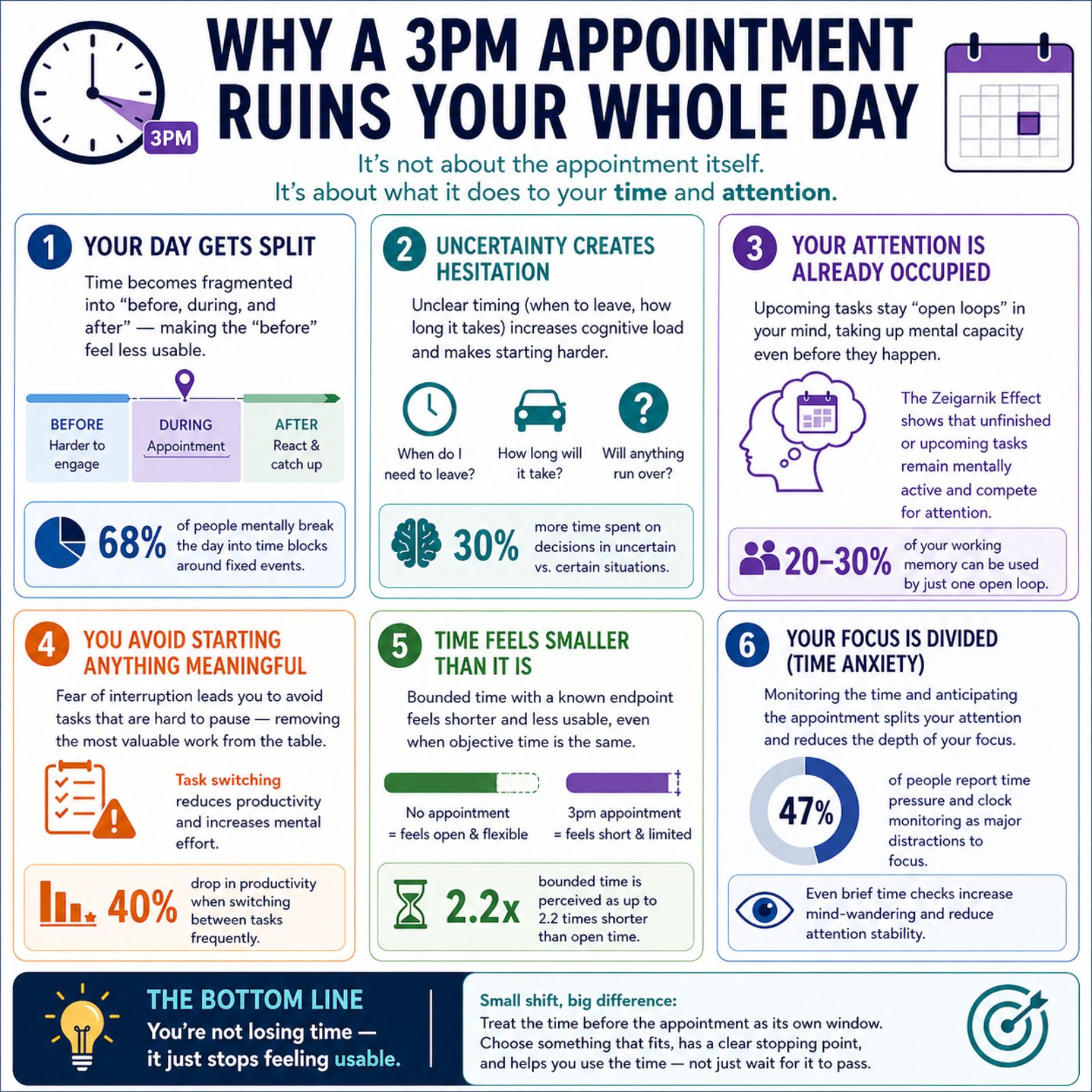
If you look more closely, the difficulty is rarely caused by the appointment itself, but rather by everything that surrounds it.
There is a degree of uncertainty - when exactly you need to leave, how long it might take, whether anything might run over - and alongside that, a quiet but persistent pressure not to get caught out.
You do not want to be halfway through something and have to abandon it abruptly. You do not want to lose track of time and find yourself rushing. And you certainly do not want to feel flustered before something that may require your attention or presence.
So your brain does what it often does in these situations... it leans towards caution.
It avoids anything that feels too absorbing, too open-ended, or too difficult to pause, which, unfortunately, removes most meaningful tasks from consideration before you have even had a chance to start them.
What remains tends to sit in an awkward middle ground - either too small to feel worthwhile, or just unclear enough to require more effort than you are willing to commit in that moment.
And so you hover waiting for something to feel simple enough to begin.
The Slightly Irrational Maths of Time
There is also something subtly misleading about how time is perceived in these situations, which only adds to the problem.
An appointment at 3pm does not, objectively, remove the entire day, nor does it meaningfully reduce the amount of time available in the morning and yet it changes how that time feels.
What would otherwise be a continuous, usable stretch becomes fragmented into sections - before, during, and after - and it is the “before” that becomes difficult to engage with because it no longer feels like open time. It feels like borrowed time.
And borrowed time, for reasons that are not entirely rational but widely experienced, is rarely used particularly well.
A Small Shift That Makes the Day Usable Again
What tends to help here is not forcing productivity into a space that does not naturally support it, but rather adjusting how that space is viewed in the first place.
Because when the underlying thought is:
“I can’t really start anything because I’ve got that thing later”
the natural outcome is hesitation.
Whereas shifting that slightly to:
“What would fit comfortably between now and then?”
creates a very different dynamic because it gives you a clearer way into action, rather than leaving you deciding what fits.
It removes the expectation that you need to make full use of the time in an ideal sense, and instead focuses on what is realistically possible within it.
A Simple “Between Now and Then” Approach
In practical terms, this means treating the time before the appointment as its own contained window, rather than as an interruption to a larger plan or something to be endured until the “real” part of the day can begin.
Within that window, the aim is not to do everything, nor is it to select the most important task available, but simply to engage with something that fits naturally within the constraints of the time you have.
That might involve:
choosing a task with a clear and comfortable stopping point, rather than one that requires extended focus
setting a loose boundary around the time you intend to spend, so that you are not constantly checking the clock
avoiding anything that feels overly complex or difficult to re-enter once paused
accepting that the output may be smaller, but still entirely worthwhile
It is not a perfect system but it is considerably more effective than allowing the entire window to pass in a state of low-level hesitation.
A Quick Note on Time Anxiety
There is often a quieter layer to all of this, which is the underlying sense of time anxiety that can sit just beneath the surface.
The awareness of the appointment drawing closer. The occasional glance at the clock, just to make sure nothing has been missed. The feeling that part of your attention needs to remain available, even while you are attempting to focus on something else which is why having something simple and contained to start from makes such a difference.
Individually, these are small things.
Collectively, they are enough to make starting feel more difficult than it should.
Not because you lack the ability to begin, but because your attention is already partially elsewhere and when attention is split like that, starting anything becomes harder than it should be.
Conclusion
If a single appointment has ever managed to derail what should have been a perfectly usable day, it is not a reflection of poor discipline or an inability to manage time effectively.
It is simply what happens when time becomes fragmented, slightly uncertain, and just pressured enough to make starting feel less straightforward than it otherwise would.
You are not losing the day. It just feels that way!
The shift, therefore, is not about reclaiming every available hour, but about making the time before the appointment usable again, even if only in smaller, more contained ways.
A simpler way to make time feel usable again
If a single appointment can disrupt your whole day, the issue isn’t time, it’s how difficult it feels to start anything within it.
Overwhelm Reset is part of the Defrazzle system designed to help with exactly that.
It gives you a simple way to reduce mental noise, lower pressure, and create a clear starting point even when your time feels fragmented.
So instead of waiting for the “right moment” to begin, you can make the time you have feel usable again.
Try Overwhelm Reset and make starting feel easier, even on disrupted days:
References
There is something quietly disruptive about having a single appointment sitting in the middle of your day, particularly when it is late enough to feel significant, but not late enough to be ignored until the time comes.
It might only take an hour. It might not even be especially important. And yet, from the moment you wake up, it has a subtle but persistent presence, as though everything else needs to arrange itself around it in ways that are not entirely logical.
You tell yourself, quite reasonably, that you have time. Plenty of it, in fact!
And yet, by the time the appointment arrives, there is a distinct sense that very little of that time has been used in the way you intended.
What’s changed isn’t the time available - it’s how usable that time feels and that’s exactly the kind of shift the Defrazzle system is designed to address.
The Day That Shrinks Around One Thing
It often begins with good intentions.
You look at the morning ahead and think that there is more than enough space to get something meaningful done before you need to leave, perhaps even mapping out a rough idea of what that might look like in practice.
But then comes the second thought, which is usually where things begin to shift:
“I probably shouldn’t start anything too involved.”
A sensible instinct, on the surface because you don’t want to get drawn into something that runs over, or find yourself having to stop halfway through something that requires more continuity than the day will allow.
So you look for something smaller, something contained, something that will fit neatly into the space available.
And somewhere in that process - deciding what qualifies as “small enough”, “worth doing”, and “unlikely to cause problems later” - the time begins to pass in a way that feels oddly unproductive, even though you have not technically done nothing. Not because there’s nothing to do, but because nothing feels like a clean enough starting point.
The Pattern That Doesn’t Quite Make Sense
This is often described as “waiting mode”, which, despite sounding slightly informal, captures the experience rather well.
Not in a clinical sense, and certainly not as something that needs over-labelling, but simply as a pattern that becomes immediately recognisable once you notice it.
You are, in effect… waiting!
Not actively, and not with any conscious decision to do so, but in a way that prevents you from fully committing to anything else, as though part of your attention has already been allocated to the thing that has yet to happen.
And what makes it particularly frustrating is the awareness that tends to sit alongside it.
You know you have time. You know you could use it.
And yet, starting anything feels slightly off, as though the timing is never quite right.
Why It Feels So Hard to Start Anything
If you look more closely, the difficulty is rarely caused by the appointment itself, but rather by everything that surrounds it.
There is a degree of uncertainty - when exactly you need to leave, how long it might take, whether anything might run over - and alongside that, a quiet but persistent pressure not to get caught out.
You do not want to be halfway through something and have to abandon it abruptly. You do not want to lose track of time and find yourself rushing. And you certainly do not want to feel flustered before something that may require your attention or presence.
So your brain does what it often does in these situations... it leans towards caution.
It avoids anything that feels too absorbing, too open-ended, or too difficult to pause, which, unfortunately, removes most meaningful tasks from consideration before you have even had a chance to start them.
What remains tends to sit in an awkward middle ground - either too small to feel worthwhile, or just unclear enough to require more effort than you are willing to commit in that moment.
And so you hover waiting for something to feel simple enough to begin.
The Slightly Irrational Maths of Time
There is also something subtly misleading about how time is perceived in these situations, which only adds to the problem.
An appointment at 3pm does not, objectively, remove the entire day, nor does it meaningfully reduce the amount of time available in the morning and yet it changes how that time feels.
What would otherwise be a continuous, usable stretch becomes fragmented into sections - before, during, and after - and it is the “before” that becomes difficult to engage with because it no longer feels like open time. It feels like borrowed time.
And borrowed time, for reasons that are not entirely rational but widely experienced, is rarely used particularly well.
A Small Shift That Makes the Day Usable Again
What tends to help here is not forcing productivity into a space that does not naturally support it, but rather adjusting how that space is viewed in the first place.
Because when the underlying thought is:
“I can’t really start anything because I’ve got that thing later”
the natural outcome is hesitation.
Whereas shifting that slightly to:
“What would fit comfortably between now and then?”
creates a very different dynamic because it gives you a clearer way into action, rather than leaving you deciding what fits.
It removes the expectation that you need to make full use of the time in an ideal sense, and instead focuses on what is realistically possible within it.
A Simple “Between Now and Then” Approach
In practical terms, this means treating the time before the appointment as its own contained window, rather than as an interruption to a larger plan or something to be endured until the “real” part of the day can begin.
Within that window, the aim is not to do everything, nor is it to select the most important task available, but simply to engage with something that fits naturally within the constraints of the time you have.
That might involve:
choosing a task with a clear and comfortable stopping point, rather than one that requires extended focus
setting a loose boundary around the time you intend to spend, so that you are not constantly checking the clock
avoiding anything that feels overly complex or difficult to re-enter once paused
accepting that the output may be smaller, but still entirely worthwhile
It is not a perfect system but it is considerably more effective than allowing the entire window to pass in a state of low-level hesitation.
A Quick Note on Time Anxiety
There is often a quieter layer to all of this, which is the underlying sense of time anxiety that can sit just beneath the surface.
The awareness of the appointment drawing closer. The occasional glance at the clock, just to make sure nothing has been missed. The feeling that part of your attention needs to remain available, even while you are attempting to focus on something else which is why having something simple and contained to start from makes such a difference.
Individually, these are small things.
Collectively, they are enough to make starting feel more difficult than it should.
Not because you lack the ability to begin, but because your attention is already partially elsewhere and when attention is split like that, starting anything becomes harder than it should be.
Conclusion
If a single appointment has ever managed to derail what should have been a perfectly usable day, it is not a reflection of poor discipline or an inability to manage time effectively.
It is simply what happens when time becomes fragmented, slightly uncertain, and just pressured enough to make starting feel less straightforward than it otherwise would.
You are not losing the day. It just feels that way!
The shift, therefore, is not about reclaiming every available hour, but about making the time before the appointment usable again, even if only in smaller, more contained ways.
A simpler way to make time feel usable again
If a single appointment can disrupt your whole day, the issue isn’t time, it’s how difficult it feels to start anything within it.
Overwhelm Reset is part of the Defrazzle system designed to help with exactly that.
It gives you a simple way to reduce mental noise, lower pressure, and create a clear starting point even when your time feels fragmented.
So instead of waiting for the “right moment” to begin, you can make the time you have feel usable again.
Try Overwhelm Reset and make starting feel easier, even on disrupted days: