The Friction Layer: Why You Still Don’t Act (Even When Things Are Clear)
The Friction Layer: Why You Still Don’t Act (Even When Things Are Clear)

You’ve got clarity.
You know what needs to be done. You’ve thought it through, you understand the outcome, and in many cases, you’ve even decided exactly what the next step should be.
And yet… you still don’t do it. Not immediately, anyway.
You pause. You hesitate. You delay slightly, sometimes without even meaning to.
Which creates a frustrating contradiction:
If things are clear, why does action still feel difficult?
Because clarity on its own isn’t enough, you also need the action to feel simple enough to begin.
That’s exactly the layer the Defrazzle system is designed to reduce.
Beyond Clarity
In The Clarity Gap, we looked at why knowing something isn’t enough because knowing doesn’t automatically translate into action.
But even when you close that gap, when things are clear, there’s still something else that can get in the way.
Something less obvious. Something that shows up not in your thinking, but in your experience of trying to act.
That’s where the next layer sits.
Introducing The Friction Layer
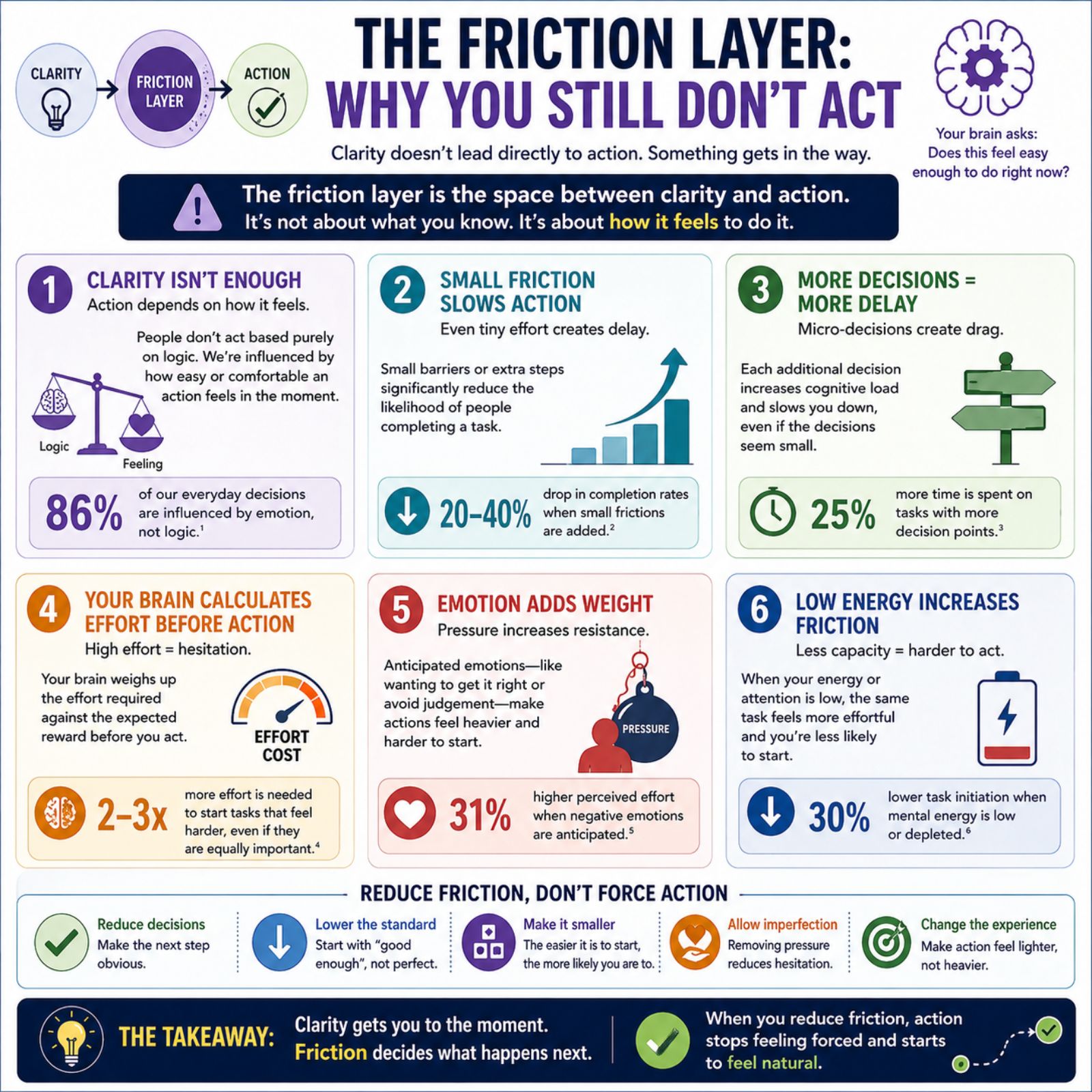
The Friction Layer is the space between clarity and action.
It’s not about what you know. It’s about how it feels to do it.
Because even when something is clear, it can still feel:
slightly heavy
harder than it should be
just unclear enough to hesitate
or not quite worth the effort in that moment
That feeling, however small, is often enough to slow you down.
Not dramatically. Just enough to delay.
And over time, those small delays compound into inaction.
What Friction Actually Looks Like
Friction isn’t always obvious.
It doesn’t usually feel like a major block. More often, it shows up in subtle ways:
You open something… and then close it again
You start… but don’t continue
You delay responding, even when it would be quick
You hesitate before beginning something simple
Each of these moments is small but they all point to the same thing:
Something about the action doesn’t feel easy enough to begin which usually means there’s still something in the moment that needs simplifying.
The Different Types of Friction
Friction isn’t one single problem.
It tends to show up in a few distinct forms, often overlapping.
Cognitive Friction
This is when there’s still too much to think about.
Even if the overall task is clear, the moment of action still requires decisions:
What exactly do I say?
How do I start this?
What’s the right way to approach it?
That mental processing creates drag.
Not enough to stop you completely but enough to slow you down.
Emotional Friction
This comes from pressure.
Not necessarily fear in a dramatic sense, but something quieter:
wanting to get it right
not wanting to say the wrong thing
being aware of how something might be received
That awareness adds weight to the action and the more weight there is, the harder it feels to begin.
Energy Friction
Sometimes the issue isn’t clarity or emotion. It’s capacity.
You might know exactly what to do, but:
you’re tired
your attention is low
your head is already full
So even simple actions feel heavier than they should and your brain looks for something easier instead.
Decision Friction
Even small decisions can create resistance.
If an action requires multiple micro-decisions, like:
what to prioritise
how much to do
what version is “good enough”
It slows everything down because each decision adds a small amount of effort and that effort accumulates.
Why Most Advice Misses This
Most advice around productivity focuses on action.
It tells you to:
“just get started”
“take action”
“stop overthinking”
But it assumes something important:
that action is neutral
That once you know what to do, doing it should be straightforward but that’s not how it works because action isn’t just logical - it’s experiential.
If something feels heavy, unclear, or effortful in the moment, your brain doesn’t push through automatically. It pauses.
So advice that ignores friction tends to fall short. Not because it’s wrong, but because it’s incomplete.
A Different Way to Think About Action
Instead of asking:
“Why am I not doing this?”
It becomes more useful to ask:
“What about this feels heavier than it should?”
That’s a much more precise question because it points directly to the friction.
And once you can see that, you can do something about it.
Reducing Friction (Rather Than Forcing Action)
The goal isn’t to push harder. It’s to make action feel lighter. Because when the starting point feels simple, action tends to follow naturally.
That might mean:
Reducing the number of decisions required - make the next step obvious.
Lowering the standard for starting - you don’t need the perfect version to begin.
Making the action smaller - the easier it is to start, the more likely you are to.
Allowing for imperfection - removing pressure reduces hesitation.
None of these change the task itself.
They change your experience of doing it and that’s what matters.
Where This Fits
If the Clarity Gap explains why you don’t start…
The Friction Layer explains why you don’t continue.
Even when things are clear, action still has to feel manageable in the moment and if it doesn’t, your brain will delay.
Not out of laziness but because the path still carries too much resistance.
Conclusion
There’s a common assumption that once something is clear, action should follow naturally but in practice, there’s another step in between.
Clarity doesn’t lead directly to action. It leads to a moment.
And in that moment, your brain assesses something simple:
Does this feel easy enough to do right now?
If the answer is yes, you move.
If it isn’t, even slightly, you hesitate.
That’s the friction layer.
And once you start noticing it, it becomes much easier to work with.
This is exactly what Defrazzle is built around.
Not just helping you understand what to do, but turning it into something that feels simple enough to act on.
By reducing both:
the gap between knowing and acting; and
the friction that sits in the middle
Because when both are addressed, action stops feeling forced and starts to feel natural.
A simpler way to reduce friction and start moving
If you’ve ever felt stuck even when things are clear, the issue isn’t knowing what to do, it’s that the action still feels heavier than it should.
Clarity Engine is part of the Defrazzle system designed to reduce that friction.
It helps you take what you already know, simplify it, and turn it into a clear, manageable next step that actually feels possible to begin.
So instead of sitting in that gap between clarity and action, you get something you can move on straight away.
Try Clarity Engine and make action feel easier to start:
References
You’ve got clarity.
You know what needs to be done. You’ve thought it through, you understand the outcome, and in many cases, you’ve even decided exactly what the next step should be.
And yet… you still don’t do it. Not immediately, anyway.
You pause. You hesitate. You delay slightly, sometimes without even meaning to.
Which creates a frustrating contradiction:
If things are clear, why does action still feel difficult?
Because clarity on its own isn’t enough, you also need the action to feel simple enough to begin.
That’s exactly the layer the Defrazzle system is designed to reduce.
Beyond Clarity
In The Clarity Gap, we looked at why knowing something isn’t enough because knowing doesn’t automatically translate into action.
But even when you close that gap, when things are clear, there’s still something else that can get in the way.
Something less obvious. Something that shows up not in your thinking, but in your experience of trying to act.
That’s where the next layer sits.
Introducing The Friction Layer
The Friction Layer is the space between clarity and action.
It’s not about what you know. It’s about how it feels to do it.
Because even when something is clear, it can still feel:
slightly heavy
harder than it should be
just unclear enough to hesitate
or not quite worth the effort in that moment
That feeling, however small, is often enough to slow you down.
Not dramatically. Just enough to delay.
And over time, those small delays compound into inaction.
What Friction Actually Looks Like
Friction isn’t always obvious.
It doesn’t usually feel like a major block. More often, it shows up in subtle ways:
You open something… and then close it again
You start… but don’t continue
You delay responding, even when it would be quick
You hesitate before beginning something simple
Each of these moments is small but they all point to the same thing:
Something about the action doesn’t feel easy enough to begin which usually means there’s still something in the moment that needs simplifying.
The Different Types of Friction
Friction isn’t one single problem.
It tends to show up in a few distinct forms, often overlapping.
Cognitive Friction
This is when there’s still too much to think about.
Even if the overall task is clear, the moment of action still requires decisions:
What exactly do I say?
How do I start this?
What’s the right way to approach it?
That mental processing creates drag.
Not enough to stop you completely but enough to slow you down.
Emotional Friction
This comes from pressure.
Not necessarily fear in a dramatic sense, but something quieter:
wanting to get it right
not wanting to say the wrong thing
being aware of how something might be received
That awareness adds weight to the action and the more weight there is, the harder it feels to begin.
Energy Friction
Sometimes the issue isn’t clarity or emotion. It’s capacity.
You might know exactly what to do, but:
you’re tired
your attention is low
your head is already full
So even simple actions feel heavier than they should and your brain looks for something easier instead.
Decision Friction
Even small decisions can create resistance.
If an action requires multiple micro-decisions, like:
what to prioritise
how much to do
what version is “good enough”
It slows everything down because each decision adds a small amount of effort and that effort accumulates.
Why Most Advice Misses This
Most advice around productivity focuses on action.
It tells you to:
“just get started”
“take action”
“stop overthinking”
But it assumes something important:
that action is neutral
That once you know what to do, doing it should be straightforward but that’s not how it works because action isn’t just logical - it’s experiential.
If something feels heavy, unclear, or effortful in the moment, your brain doesn’t push through automatically. It pauses.
So advice that ignores friction tends to fall short. Not because it’s wrong, but because it’s incomplete.
A Different Way to Think About Action
Instead of asking:
“Why am I not doing this?”
It becomes more useful to ask:
“What about this feels heavier than it should?”
That’s a much more precise question because it points directly to the friction.
And once you can see that, you can do something about it.
Reducing Friction (Rather Than Forcing Action)
The goal isn’t to push harder. It’s to make action feel lighter. Because when the starting point feels simple, action tends to follow naturally.
That might mean:
Reducing the number of decisions required - make the next step obvious.
Lowering the standard for starting - you don’t need the perfect version to begin.
Making the action smaller - the easier it is to start, the more likely you are to.
Allowing for imperfection - removing pressure reduces hesitation.
None of these change the task itself.
They change your experience of doing it and that’s what matters.
Where This Fits
If the Clarity Gap explains why you don’t start…
The Friction Layer explains why you don’t continue.
Even when things are clear, action still has to feel manageable in the moment and if it doesn’t, your brain will delay.
Not out of laziness but because the path still carries too much resistance.
Conclusion
There’s a common assumption that once something is clear, action should follow naturally but in practice, there’s another step in between.
Clarity doesn’t lead directly to action. It leads to a moment.
And in that moment, your brain assesses something simple:
Does this feel easy enough to do right now?
If the answer is yes, you move.
If it isn’t, even slightly, you hesitate.
That’s the friction layer.
And once you start noticing it, it becomes much easier to work with.
This is exactly what Defrazzle is built around.
Not just helping you understand what to do, but turning it into something that feels simple enough to act on.
By reducing both:
the gap between knowing and acting; and
the friction that sits in the middle
Because when both are addressed, action stops feeling forced and starts to feel natural.
A simpler way to reduce friction and start moving
If you’ve ever felt stuck even when things are clear, the issue isn’t knowing what to do, it’s that the action still feels heavier than it should.
Clarity Engine is part of the Defrazzle system designed to reduce that friction.
It helps you take what you already know, simplify it, and turn it into a clear, manageable next step that actually feels possible to begin.
So instead of sitting in that gap between clarity and action, you get something you can move on straight away.
Try Clarity Engine and make action feel easier to start: