Why Unclear Instructions Completely Shut You Down
Why Unclear Instructions Completely Shut You Down

You’re given a task. Sounds simple enough.
Then the instructions come in… and something feels off.
The instructions are vague and slightly unclear. They are also missing detail. And suddenly, instead of getting started, you hesitate. You reread. You try to piece things together. Maybe you even open the task… then quietly avoid it.
It looks and feels like procrastination but it’s not.
Because when things are clear, you move quickly. You don’t overthink. You just get on with it.
So what’s the difference?
Ambiguity.
And more specifically - ambiguity creating cognitive overload.
This is exactly the kind of situation the Defrazzle system is designed for - turning unclear instructions into something structured and usable.
Your brain is trying to:
figure out what’s actually being asked
fill in missing steps
avoid doing it “wrong”
decide where to even begin
All at once.
So instead of moving forward, what does it do? It stalls.
Let’s break this down properly, because once you understand it, you can stop blaming yourself and start working around it.
What’s Actually Happening When Instructions Are Unclear
You’ve probably had this experience more than once.
A message lands. A task gets assigned. Someone explains something quickly and then moves on.
And you’re left thinking: “Wait… what exactly am I supposed to do here?”
At that point, most people assume they just need to think it through more carefully or more thoroughly.
But that’s not what’s happening.
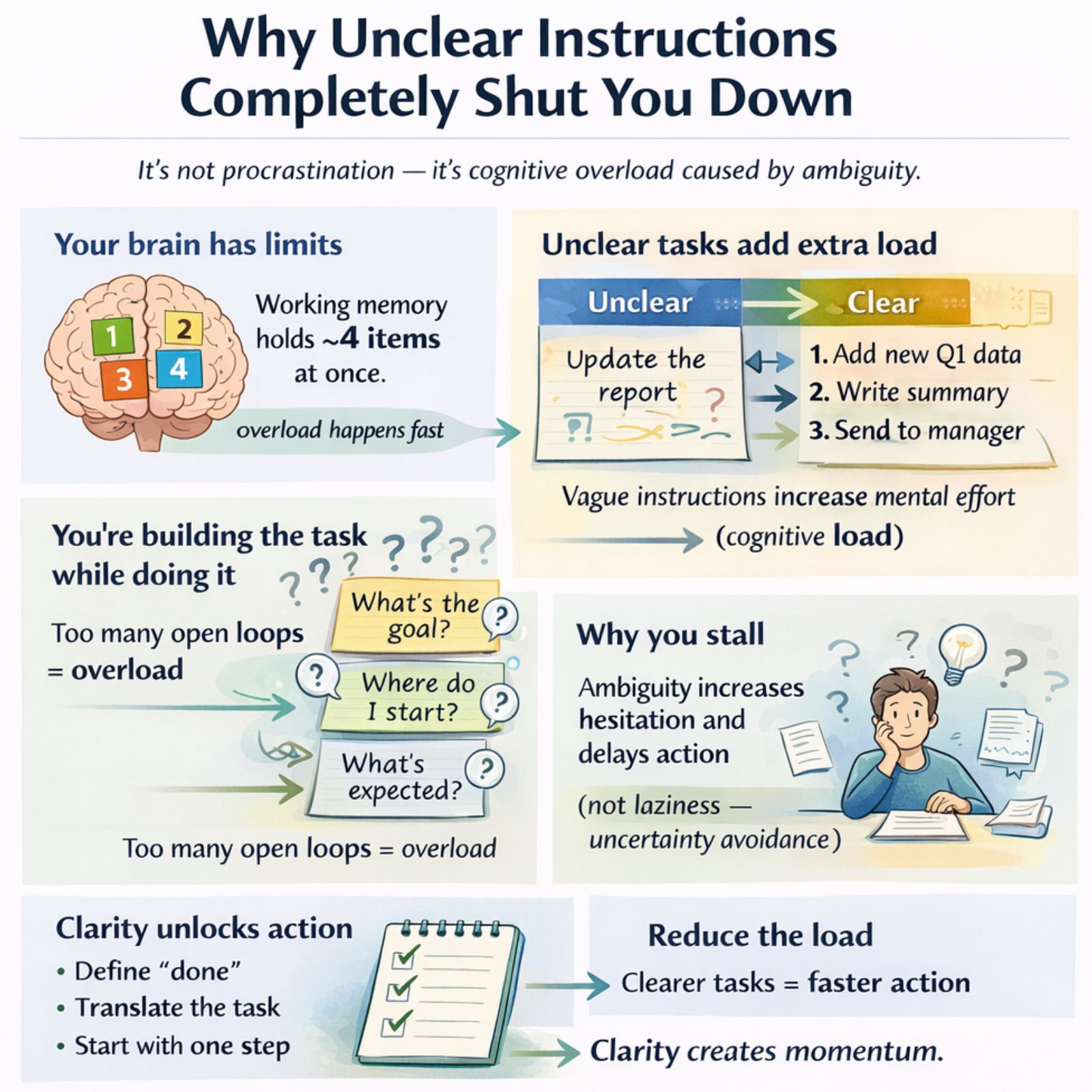
When instructions are unclear, your brain doesn’t just process the task - it has to build the task from scratch. You’re not following steps; you’re trying to create them while also trying to complete them and without a clear structure to work from, that’s where the overload builds.
Instead of focusing on doing the work, your brain is juggling multiple questions at once:
What’s the end goal here?
What does “done” actually look like?
What’s the first step?
What’s expected vs optional?
And because there’s no clear answer, everything stays open.
This is exactly where ambiguity turns into cognitive overload, and when that happens, your brain defaults to the safest option:
Pause. Stop. Abort!
And this has nothing to do with you being lazy or because you lack discipline. It's critically because it’s unclear.
What to do instead
If you don’t have a way to clarify the task, your brain tries to do all of this at once and that’s what creates the friction. The goal isn’t to push through confusion here; it’s to reduce it:
Translate the task into a clearer version in your own words - if you can’t explain it simply, you don’t understand it yet.
Define what “done” looks like - even a rough version is enough to give you direction.
Break it into the smallest possible first step - not the whole task, just where to begin.
Accept that your version might not be perfect - clarity improves as you move forwards, not before.
Why You End Up Avoiding It (Without Realising)
This is where it gets frustrating because, from the outside, it looks like you’re putting it off.
You might:
delay starting
switch to easier tasks
keep “preparing” instead of doing
And it starts to feel (and look from certain perspectives) like procrastination.
But what’s actually happening is more specific than that.
When a task is unclear, your brain can’t map a clean path from start to finish. And without that path, it can’t predict how long it will take, how difficult it will be, or whether you’ll get it right.
That uncertainty creates friction.
So instead of moving forward, your brain looks for something easier and importantly, something clearer.
That’s not avoidance in the usual sense. It’s your brain choosing clarity over confusion.
Why typical advice doesn’t help
You’ll hear things like:
“Just get started”
“Stop procrastinating”
“Break it down”
But those only work after the task is clear.
If the instructions themselves are vague, you’re trying to break down something that hasn’t even been defined properly yet.
So the friction stays.
A better way to think about it
You’re not avoiding the task. You’re avoiding unclear thinking.
And that’s a very different problem.
What helps is having a simple way to turn that unclear input into something you can actually work with.
How to move past it
Instead of forcing action, focus on creating clarity first:
Ask one specific question - not everything; just the one thing blocking you most.
Set a rough direction, not a perfect plan - you don’t need full certainty to begin.
Give yourself permission to be wrong initially - starting unclear is better than staying stuck.
The Pressure of “Getting It Right” Makes It Worse
Unclear instructions don’t just create confusion, they create pressure.
Because now you’re not only trying to figure out what to do, you’re also trying to avoid doing it incorrectly.
And that adds another layer of load:
“What if I misunderstand this?”
“What if I do it wrong and have to redo it?”
“What if I’ve missed something obvious?”
So instead of making a move, you stay in analysis mode trying to reduce the risk.
But here’s the problem - you can’t eliminate that risk before you start.
Why this keeps you stuck
Most people assume they need more clarity before they act.
But when instructions are vague, that clarity often only comes through doing (or certainly starting) the task, not before it.
So waiting doesn’t actually solve it, it prolongs it.
The shift that helps
You don’t need perfect understanding. You need a workable interpretation. Something you can act on, test, and adjust.
How to lower the pressure
Aim for a first version, not a final version - your goal is movement, not perfection.
Assume iteration is part of the process - you’ll refine as you go.
Focus on progress over correctness - done imperfectly beats stuck perfectly.
How to Deal With Unclear Instructions in Real Time
This is the part that makes the biggest difference because unclear instructions aren’t going away.
So instead of hoping for better clarity, you need a way to handle it when it shows up. Something that helps you quickly turn confusion into something usable.
Simple ways to respond (without overthinking it)
“Just to check, do you mean…?” - clarifies direction quickly without overcomplicating things.
“What would a good outcome look like here?” - focuses on the end goal instead of the steps.
“What’s the most important part of this?” - helps prioritise when everything feels vague.
“I’ll start with X. Does that sound right?” - shows initiative while still checking alignment.
These aren’t just questions - they’re simple tools that reduce ambiguity and make the task easier to act on.
They reduce the mental load immediately, which is what allows you to move.
How to Make Tasks Feel Easier Going Forward
If this is something that happens regularly, the goal isn’t to avoid unclear instructions altogether, it’s to reduce how much they affect you.
Right now, the moment something feels vague, your brain shifts into overdrive trying to fill in gaps, predict outcomes, and avoid mistakes and that’s what creates the shutdown.
So the long-term shift is about changing how you approach that moment.
What helps over time
Expect some level of ambiguity - not everything will be fully clear and that’s normal.
Focus on the next step, not the full picture - clarity builds as you move forwards.
Get comfortable asking for clarification early - it saves time and definitely doesn't waste it.
Treat unclear tasks as drafts, not final instructions - you’re allowed to shape them as you go.
Over time, this reduces the pressure you feel when something isn’t perfectly defined.
And when the pressure drops, so does the shutdown.
Conclusion
If unclear instructions shut you down, it’s not because you lack motivation or discipline. It’s because your brain is trying to process too much without enough structure.
You’ve been expected to:
figure out what’s being asked
decide how to approach it
avoid getting it wrong
and take action
All at the same time.
And that’s where the overload happens. So your brain pauses.
The shift is simple, but it changes everything.
You don’t need to push harder. You don’t need to “try to focus more.” You need to reduce the ambiguity.
Start by clarifying the outcome then define the first step. Then you're ready to move forwards. Because once the task feels clear (even slightly) momentum becomes much easier.
A simpler way to handle unclear instructions
If unclear instructions slow you down, the problem isn’t effort, it’s that you’re being asked to work with something that isn’t clear yet.
Ambiguity Translator is part of the Defrazzle system designed to solve exactly that.
It takes unclear instructions, messages, or tasks and turns them into something structured, understandable, and easier to act on.
So instead of trying to piece everything together in your head, you get a clearer starting point straight away.
Try the Ambiguity Translator and turn confusion into clarity:
References
You’re given a task. Sounds simple enough.
Then the instructions come in… and something feels off.
The instructions are vague and slightly unclear. They are also missing detail. And suddenly, instead of getting started, you hesitate. You reread. You try to piece things together. Maybe you even open the task… then quietly avoid it.
It looks and feels like procrastination but it’s not.
Because when things are clear, you move quickly. You don’t overthink. You just get on with it.
So what’s the difference?
Ambiguity.
And more specifically - ambiguity creating cognitive overload.
This is exactly the kind of situation the Defrazzle system is designed for - turning unclear instructions into something structured and usable.
Your brain is trying to:
figure out what’s actually being asked
fill in missing steps
avoid doing it “wrong”
decide where to even begin
All at once.
So instead of moving forward, what does it do? It stalls.
Let’s break this down properly, because once you understand it, you can stop blaming yourself and start working around it.
What’s Actually Happening When Instructions Are Unclear
You’ve probably had this experience more than once.
A message lands. A task gets assigned. Someone explains something quickly and then moves on.
And you’re left thinking: “Wait… what exactly am I supposed to do here?”
At that point, most people assume they just need to think it through more carefully or more thoroughly.
But that’s not what’s happening.
When instructions are unclear, your brain doesn’t just process the task - it has to build the task from scratch. You’re not following steps; you’re trying to create them while also trying to complete them and without a clear structure to work from, that’s where the overload builds.
Instead of focusing on doing the work, your brain is juggling multiple questions at once:
What’s the end goal here?
What does “done” actually look like?
What’s the first step?
What’s expected vs optional?
And because there’s no clear answer, everything stays open.
This is exactly where ambiguity turns into cognitive overload, and when that happens, your brain defaults to the safest option:
Pause. Stop. Abort!
And this has nothing to do with you being lazy or because you lack discipline. It's critically because it’s unclear.
What to do instead
If you don’t have a way to clarify the task, your brain tries to do all of this at once and that’s what creates the friction. The goal isn’t to push through confusion here; it’s to reduce it:
Translate the task into a clearer version in your own words - if you can’t explain it simply, you don’t understand it yet.
Define what “done” looks like - even a rough version is enough to give you direction.
Break it into the smallest possible first step - not the whole task, just where to begin.
Accept that your version might not be perfect - clarity improves as you move forwards, not before.
Why You End Up Avoiding It (Without Realising)
This is where it gets frustrating because, from the outside, it looks like you’re putting it off.
You might:
delay starting
switch to easier tasks
keep “preparing” instead of doing
And it starts to feel (and look from certain perspectives) like procrastination.
But what’s actually happening is more specific than that.
When a task is unclear, your brain can’t map a clean path from start to finish. And without that path, it can’t predict how long it will take, how difficult it will be, or whether you’ll get it right.
That uncertainty creates friction.
So instead of moving forward, your brain looks for something easier and importantly, something clearer.
That’s not avoidance in the usual sense. It’s your brain choosing clarity over confusion.
Why typical advice doesn’t help
You’ll hear things like:
“Just get started”
“Stop procrastinating”
“Break it down”
But those only work after the task is clear.
If the instructions themselves are vague, you’re trying to break down something that hasn’t even been defined properly yet.
So the friction stays.
A better way to think about it
You’re not avoiding the task. You’re avoiding unclear thinking.
And that’s a very different problem.
What helps is having a simple way to turn that unclear input into something you can actually work with.
How to move past it
Instead of forcing action, focus on creating clarity first:
Ask one specific question - not everything; just the one thing blocking you most.
Set a rough direction, not a perfect plan - you don’t need full certainty to begin.
Give yourself permission to be wrong initially - starting unclear is better than staying stuck.
The Pressure of “Getting It Right” Makes It Worse
Unclear instructions don’t just create confusion, they create pressure.
Because now you’re not only trying to figure out what to do, you’re also trying to avoid doing it incorrectly.
And that adds another layer of load:
“What if I misunderstand this?”
“What if I do it wrong and have to redo it?”
“What if I’ve missed something obvious?”
So instead of making a move, you stay in analysis mode trying to reduce the risk.
But here’s the problem - you can’t eliminate that risk before you start.
Why this keeps you stuck
Most people assume they need more clarity before they act.
But when instructions are vague, that clarity often only comes through doing (or certainly starting) the task, not before it.
So waiting doesn’t actually solve it, it prolongs it.
The shift that helps
You don’t need perfect understanding. You need a workable interpretation. Something you can act on, test, and adjust.
How to lower the pressure
Aim for a first version, not a final version - your goal is movement, not perfection.
Assume iteration is part of the process - you’ll refine as you go.
Focus on progress over correctness - done imperfectly beats stuck perfectly.
How to Deal With Unclear Instructions in Real Time
This is the part that makes the biggest difference because unclear instructions aren’t going away.
So instead of hoping for better clarity, you need a way to handle it when it shows up. Something that helps you quickly turn confusion into something usable.
Simple ways to respond (without overthinking it)
“Just to check, do you mean…?” - clarifies direction quickly without overcomplicating things.
“What would a good outcome look like here?” - focuses on the end goal instead of the steps.
“What’s the most important part of this?” - helps prioritise when everything feels vague.
“I’ll start with X. Does that sound right?” - shows initiative while still checking alignment.
These aren’t just questions - they’re simple tools that reduce ambiguity and make the task easier to act on.
They reduce the mental load immediately, which is what allows you to move.
How to Make Tasks Feel Easier Going Forward
If this is something that happens regularly, the goal isn’t to avoid unclear instructions altogether, it’s to reduce how much they affect you.
Right now, the moment something feels vague, your brain shifts into overdrive trying to fill in gaps, predict outcomes, and avoid mistakes and that’s what creates the shutdown.
So the long-term shift is about changing how you approach that moment.
What helps over time
Expect some level of ambiguity - not everything will be fully clear and that’s normal.
Focus on the next step, not the full picture - clarity builds as you move forwards.
Get comfortable asking for clarification early - it saves time and definitely doesn't waste it.
Treat unclear tasks as drafts, not final instructions - you’re allowed to shape them as you go.
Over time, this reduces the pressure you feel when something isn’t perfectly defined.
And when the pressure drops, so does the shutdown.
Conclusion
If unclear instructions shut you down, it’s not because you lack motivation or discipline. It’s because your brain is trying to process too much without enough structure.
You’ve been expected to:
figure out what’s being asked
decide how to approach it
avoid getting it wrong
and take action
All at the same time.
And that’s where the overload happens. So your brain pauses.
The shift is simple, but it changes everything.
You don’t need to push harder. You don’t need to “try to focus more.” You need to reduce the ambiguity.
Start by clarifying the outcome then define the first step. Then you're ready to move forwards. Because once the task feels clear (even slightly) momentum becomes much easier.
A simpler way to handle unclear instructions
If unclear instructions slow you down, the problem isn’t effort, it’s that you’re being asked to work with something that isn’t clear yet.
Ambiguity Translator is part of the Defrazzle system designed to solve exactly that.
It takes unclear instructions, messages, or tasks and turns them into something structured, understandable, and easier to act on.
So instead of trying to piece everything together in your head, you get a clearer starting point straight away.
Try the Ambiguity Translator and turn confusion into clarity: