Borrowing Someone Else’s Presence: How Body Doubling Actually Helps
Borrowing Someone Else’s Presence: How Body Doubling Actually Helps

There are certain tasks that, for reasons that are not always easy to explain, seem to sit perfectly still until another human being enters the picture.
Not to help. Not to advise. Not even to contribute in any meaningful way.
Just… to be there. It is one of those slightly odd patterns you might notice over time, often without fully questioning it at first, where something you have been meaning to do for hours, sometimes days, suddenly becomes easier to begin the moment someone else is nearby, even if they are doing something entirely unrelated.
You are still doing the same task.
Nothing about the task itself has changed.
And yet, somehow, you have!
What’s changed isn’t the task - it’s the conditions around starting it and that’s exactly the kind of shift the Defrazzle system is designed to create.
The Quiet Reality of “I’ll Do It Later”
I used to notice this most with things that sat somewhere between “important” and “not urgent enough to force action”.
Emails, for example. Or admin tasks that required just enough thought to be mildly inconvenient.
Left to my own devices, I could quite happily circle those tasks for longer than I’d like to admit, occasionally opening them, considering them briefly, and then closing them again with the quiet assurance that I would return to them shortly.
Which, of course, I often didn’t. Not because the task was difficult, but because starting it felt just out of reach.
And yet, place me in a room where someone else was working - whether that was a colleague, a friend, or even someone on a call - and those same tasks suddenly felt far more approachable, as though the barrier to starting had quietly lowered without me fully noticing when it happened.
What “Body Doubling” Actually Is (Without Overcomplicating It)
This is what is commonly referred to as body doubling, although, despite the label, it is not particularly complicated.
At its simplest, it is the act of doing something alongside another person, where their presence (whether physical or virtual) creates just enough structure, awareness, or accountability to make starting and continuing feel easier.
They are not there to manage you. They are not there to supervise you. In many cases, they are not even paying attention to what you are doing. And yet, their presence has an effect.
Not dramatic but noticeable.
Why It Works More Than It Probably Should
There are a few reasons why this tends to work, although none of them require a particularly technical explanation to recognise.
Part of it is awareness.
When someone else is present, even passively, there is a subtle shift in how you engage with your time, as though your attention becomes slightly more anchored, slightly less likely to drift without consequence.
Part of it is momentum.
Starting something in isolation often requires you to generate that momentum entirely on your own, whereas with another person nearby, some of that resistance seems to dissipate before it fully forms.
And part of it, if we are being honest, is that it is simply harder to ignore something when someone else is also occupying the same space, even if they are not involved in what you are doing.
You do not suddenly become more capable. You just become slightly more likely to begin and often, that small shift in starting is all that’s needed to move things forward.
Which, as it turns out, is often the hardest part.
When It Works (And When It Doesn’t)
Like most things, body doubling is not universally effective, nor is it a solution to every situation.
It tends to work best for tasks that are:
clear enough to begin, but difficult to start
slightly tedious or repetitive
easy to abandon when left entirely to your own attention
It is particularly useful when the issue is not understanding what to do, but simply getting going.
Where it tends to fall short is in situations that require deep, uninterrupted thinking, or where the presence of another person becomes more distracting than supportive.
There is also the small but important detail that the other person needs to be the right kind of presence.
Someone who allows space, rather than filling it. Someone who is there, but not overly involved.
Which, when you say it out loud, sounds simple.
In practice, it is occasionally a little more nuanced.
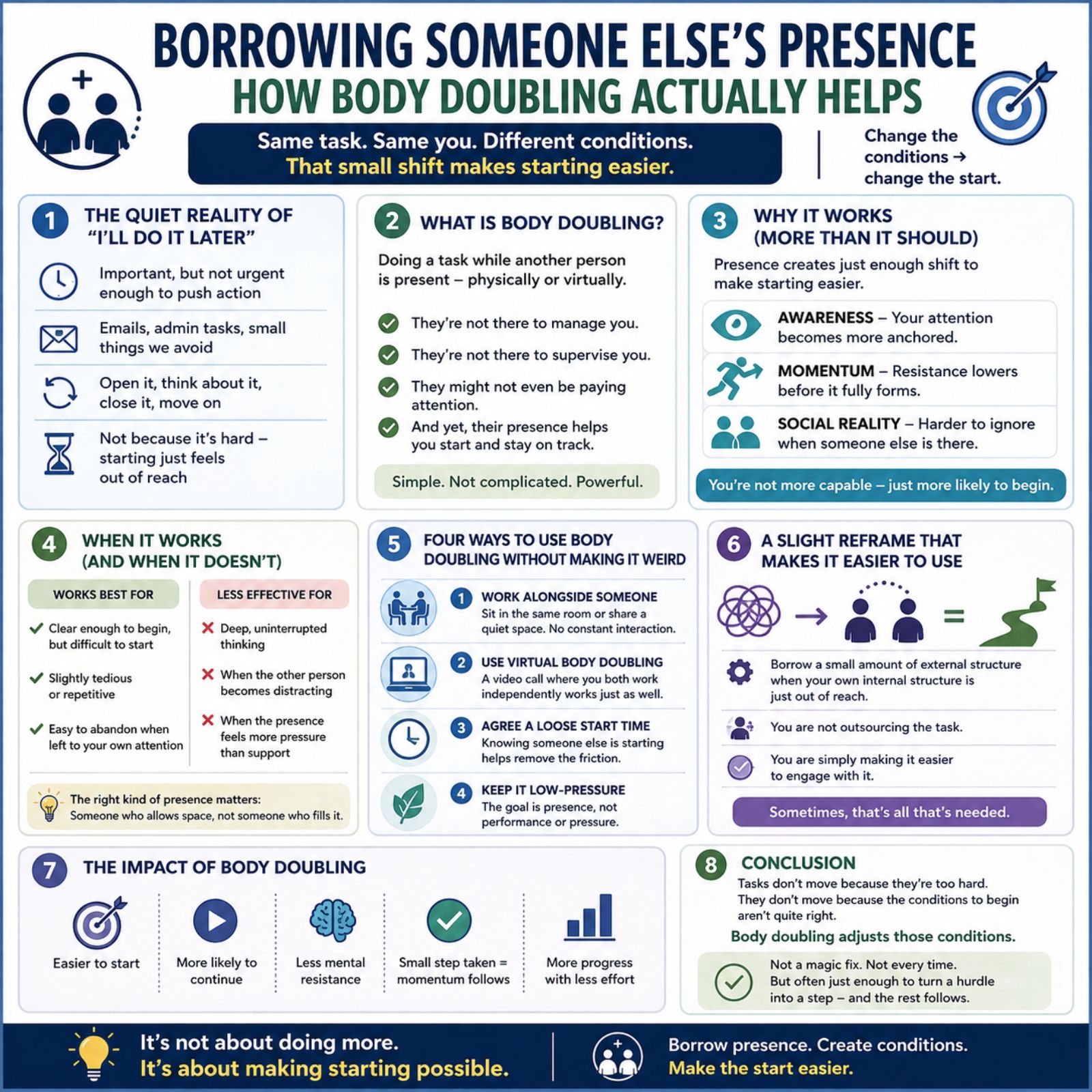
Four Ways to Use Body Doubling Without Making It Weird
The idea of deliberately “using” another person’s presence can feel slightly unnatural at first, as though you are introducing unnecessary structure into something that should be more straightforward.
In reality, it does not need to be complicated at all.
In fact, the simpler it is, the better it tends to work.
A few ways this can look in practice:
Working alongside someone without needing to interact constantly - this could be as simple as sitting in the same room, or even just sharing a quiet space where both of you are doing your own thing.
Using virtual body doubling when physical presence isn’t practical - a video call where both people are working independently can often create the same effect, without requiring conversation or coordination beyond showing up.
Agreeing a loose “start time” together - knowing that someone else is beginning at the same time can remove the friction of starting alone, even if you are working on entirely separate tasks.
Keeping it intentionally low-pressure - the moment it starts to feel like accountability in a formal sense, it tends to lose its effectiveness; the goal is presence, not performance.
None of this is particularly structured and that is precisely why it works.
A Slight Reframe That Makes It Easier to Use
It can be helpful to think of body doubling not as a productivity technique, but as a way of borrowing a small amount of external structure when your own internal structure feels just out of reach. When that structure isn’t there, the friction of starting tends to return.
You are not outsourcing the task. You are simply making it easier to engage with it.
And in many cases, that is all that is needed.
Conclusion
Some tasks do not move because they are too difficult, or too complex, or even too time-consuming.
They simply do not move because the conditions to begin them are not quite right. When those conditions become clearer or lighter, starting becomes much easier.
Body doubling, in its simplest form, adjusts those conditions.
Not dramatically, and not in a way that guarantees progress every time, but often just enough to make starting feel less like a hurdle and more like a step.
And once that step is taken, the rest tends to follow with far less resistance than expected.
A simpler way to make starting feel easier
If tasks feel easier to start when someone else is around, it’s not about the task, it’s about the conditions around it.
Overwhelm Reset is part of the Defrazzle system designed to help with exactly that.
It gives you a simple way to reduce mental noise, lower pressure, and create a starting point without needing external structure or another person present.
So instead of waiting for the “right moment” to begin, you can create one for yourself.
Try Overwhelm Reset and make starting feel more manageable:
References
Zajonc, R. B. (1965) - Social Facilitation
There are certain tasks that, for reasons that are not always easy to explain, seem to sit perfectly still until another human being enters the picture.
Not to help. Not to advise. Not even to contribute in any meaningful way.
Just… to be there. It is one of those slightly odd patterns you might notice over time, often without fully questioning it at first, where something you have been meaning to do for hours, sometimes days, suddenly becomes easier to begin the moment someone else is nearby, even if they are doing something entirely unrelated.
You are still doing the same task.
Nothing about the task itself has changed.
And yet, somehow, you have!
What’s changed isn’t the task - it’s the conditions around starting it and that’s exactly the kind of shift the Defrazzle system is designed to create.
The Quiet Reality of “I’ll Do It Later”
I used to notice this most with things that sat somewhere between “important” and “not urgent enough to force action”.
Emails, for example. Or admin tasks that required just enough thought to be mildly inconvenient.
Left to my own devices, I could quite happily circle those tasks for longer than I’d like to admit, occasionally opening them, considering them briefly, and then closing them again with the quiet assurance that I would return to them shortly.
Which, of course, I often didn’t. Not because the task was difficult, but because starting it felt just out of reach.
And yet, place me in a room where someone else was working - whether that was a colleague, a friend, or even someone on a call - and those same tasks suddenly felt far more approachable, as though the barrier to starting had quietly lowered without me fully noticing when it happened.
What “Body Doubling” Actually Is (Without Overcomplicating It)
This is what is commonly referred to as body doubling, although, despite the label, it is not particularly complicated.
At its simplest, it is the act of doing something alongside another person, where their presence (whether physical or virtual) creates just enough structure, awareness, or accountability to make starting and continuing feel easier.
They are not there to manage you. They are not there to supervise you. In many cases, they are not even paying attention to what you are doing. And yet, their presence has an effect.
Not dramatic but noticeable.
Why It Works More Than It Probably Should
There are a few reasons why this tends to work, although none of them require a particularly technical explanation to recognise.
Part of it is awareness.
When someone else is present, even passively, there is a subtle shift in how you engage with your time, as though your attention becomes slightly more anchored, slightly less likely to drift without consequence.
Part of it is momentum.
Starting something in isolation often requires you to generate that momentum entirely on your own, whereas with another person nearby, some of that resistance seems to dissipate before it fully forms.
And part of it, if we are being honest, is that it is simply harder to ignore something when someone else is also occupying the same space, even if they are not involved in what you are doing.
You do not suddenly become more capable. You just become slightly more likely to begin and often, that small shift in starting is all that’s needed to move things forward.
Which, as it turns out, is often the hardest part.
When It Works (And When It Doesn’t)
Like most things, body doubling is not universally effective, nor is it a solution to every situation.
It tends to work best for tasks that are:
clear enough to begin, but difficult to start
slightly tedious or repetitive
easy to abandon when left entirely to your own attention
It is particularly useful when the issue is not understanding what to do, but simply getting going.
Where it tends to fall short is in situations that require deep, uninterrupted thinking, or where the presence of another person becomes more distracting than supportive.
There is also the small but important detail that the other person needs to be the right kind of presence.
Someone who allows space, rather than filling it. Someone who is there, but not overly involved.
Which, when you say it out loud, sounds simple.
In practice, it is occasionally a little more nuanced.
Four Ways to Use Body Doubling Without Making It Weird
The idea of deliberately “using” another person’s presence can feel slightly unnatural at first, as though you are introducing unnecessary structure into something that should be more straightforward.
In reality, it does not need to be complicated at all.
In fact, the simpler it is, the better it tends to work.
A few ways this can look in practice:
Working alongside someone without needing to interact constantly - this could be as simple as sitting in the same room, or even just sharing a quiet space where both of you are doing your own thing.
Using virtual body doubling when physical presence isn’t practical - a video call where both people are working independently can often create the same effect, without requiring conversation or coordination beyond showing up.
Agreeing a loose “start time” together - knowing that someone else is beginning at the same time can remove the friction of starting alone, even if you are working on entirely separate tasks.
Keeping it intentionally low-pressure - the moment it starts to feel like accountability in a formal sense, it tends to lose its effectiveness; the goal is presence, not performance.
None of this is particularly structured and that is precisely why it works.
A Slight Reframe That Makes It Easier to Use
It can be helpful to think of body doubling not as a productivity technique, but as a way of borrowing a small amount of external structure when your own internal structure feels just out of reach. When that structure isn’t there, the friction of starting tends to return.
You are not outsourcing the task. You are simply making it easier to engage with it.
And in many cases, that is all that is needed.
Conclusion
Some tasks do not move because they are too difficult, or too complex, or even too time-consuming.
They simply do not move because the conditions to begin them are not quite right. When those conditions become clearer or lighter, starting becomes much easier.
Body doubling, in its simplest form, adjusts those conditions.
Not dramatically, and not in a way that guarantees progress every time, but often just enough to make starting feel less like a hurdle and more like a step.
And once that step is taken, the rest tends to follow with far less resistance than expected.
A simpler way to make starting feel easier
If tasks feel easier to start when someone else is around, it’s not about the task, it’s about the conditions around it.
Overwhelm Reset is part of the Defrazzle system designed to help with exactly that.
It gives you a simple way to reduce mental noise, lower pressure, and create a starting point without needing external structure or another person present.
So instead of waiting for the “right moment” to begin, you can create one for yourself.
Try Overwhelm Reset and make starting feel more manageable:
References
Zajonc, R. B. (1965) - Social Facilitation