Why Your Mind Goes Blank in Conversations
Why Your Mind Goes Blank in Conversations

You know what you want to say… until the critical moment comes to say something.
Then your mind goes completely blank!
It’s that split second where the conversation turns to you, and instead of responding naturally, everything just… stops. You can feel the pressure building, the silence stretching, and the harder you try to think of something to say, the worse it gets.
Afterwards, it’s even more frustrating. Because the words do come back. Usually too late. You replay the moment in your head thinking, “Why didn’t I just say that?”
So you start assuming it’s a confidence issue. Or that you’re just “not good at conversations.”
But that’s not what’s actually happening.
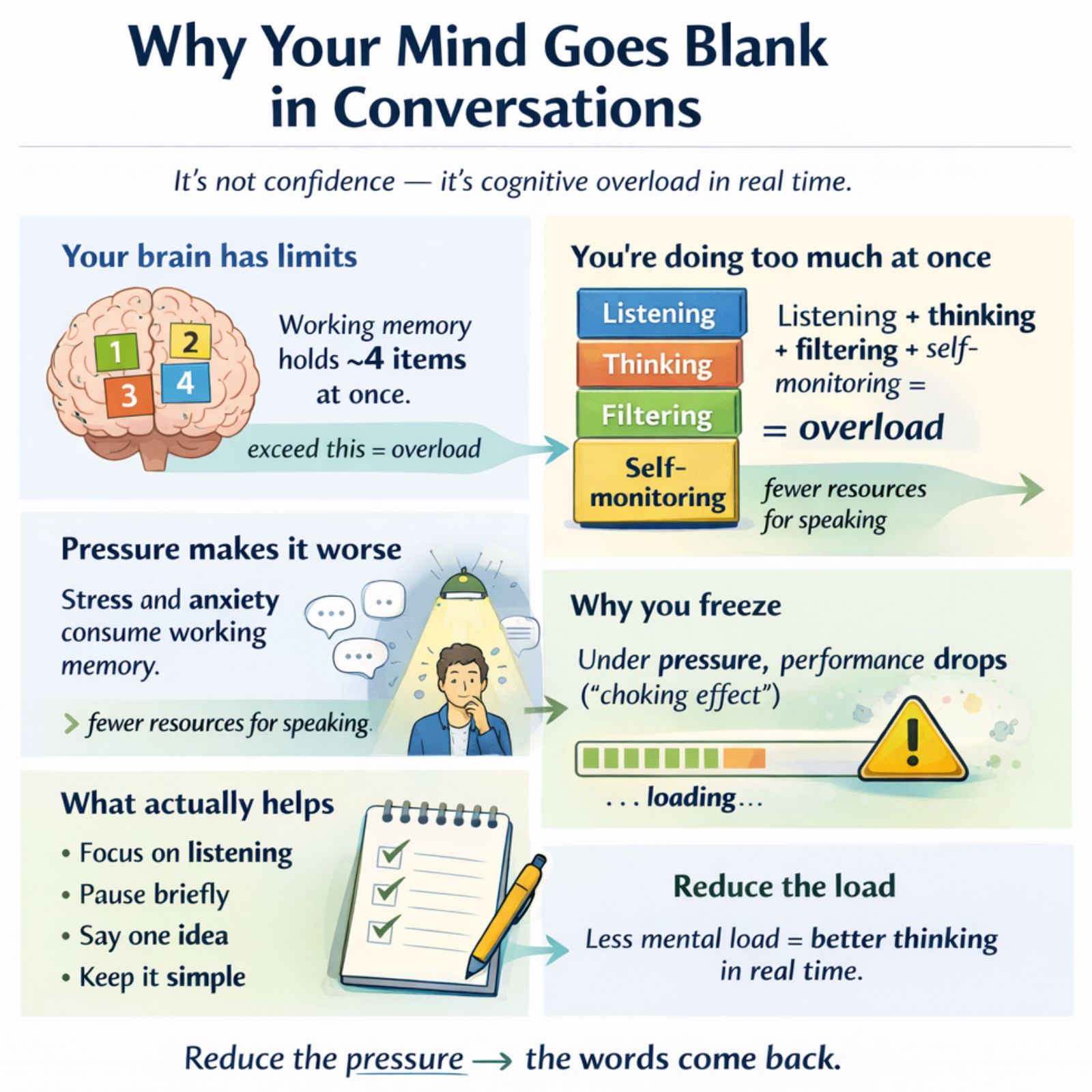
This isn’t about confidence. It’s cognitive overload in real time.
This is exactly the kind of moment the Defrazzle system is designed for - reducing that load and giving you something clear to say when your mind stalls.
Your brain is trying to:
find the right words
avoid saying the wrong thing
process what’s being said
manage how you’re coming across
All at once!
So, unsurprisingly, it shuts down.
Let’s break this down properly, because once you understand it, you can stop fighting it and then start handling conversations much more easily.
What’s Actually Happening When Your Mind Goes Blank
You’ve likely experienced this most in situations that matter, well, most.
Work meetings. Important social settings. Conversations with people you want to impress.
You’re following along just fine until suddenly, you’re expected to contribute.
And that’s when everything stalls!
Here’s what’s actually happening under the surface.
Your brain isn’t designed to handle multiple layers of pressure at once, especially in real time. But in conversations like these, you’re not just listening. You’re simultaneously trying to interpret meaning, prepare a response, filter what’s appropriate, and monitor how you’re being perceived.
That’s a lot!
So instead of prioritising one thing, your brain tries to handle all of it and ends up doing none of it well. This is where cognitive overload kicks in, and when that threshold is crossed, your brain defaults to the safest option:
Pause everything. That’s the “blank” feeling.
Most people assume they need to think faster or be more articulate, but speed isn’t the issue. The issue is that you’re trying to run too many processes at once.
What to do instead
When you don’t have a simple way to handle this, your brain tries to manage everything at once and that’s what creates the freeze. The goal isn’t to force clarity. It’s to reduce the load:
Focus on listening first, not replying - let the other person finish without mentally rehearsing your response.
Give yourself permission to pause - a short pause doesn’t make you look awkward. In fact it makes you look considered.
Stop trying to say the perfect thing - "good enough” keeps conversations moving. Perfection stops them.
Anchor to one simple idea - you don’t need a full response: just one clear point is enough.
Why “Just Be More Confident” Doesn’t Work
You’ve probably heard this before:
“Just be more confident.”
“Speak up.”
It sounds helpful but it doesn’t solve the problem.
Because when your mind goes blank, it’s not a mindset issue - it’s a processing issue.
Confidence doesn’t remove the mental load you’re under in that moment. If anything, trying to “be confident” can actually make things worse, because now you’re adding another layer of pressure - performing confidence - on top of everything else.
So instead of helping, it reinforces the cycle:
You freeze
You feel like you handled it badly
You go into the next conversation with more pressure
And the pattern repeats.
The real issue is that you’ve been trying to manage too many things at once without a system for handling them. What helps is having something simple to fall back on so you’re not trying to generate the perfect response from scratch every time.
A better way to think about it
You don’t need to become more confident before you speak.
You need to make speaking easier on your brain. That’s the shift!
How to reduce the pressure in real time
Drop the need to impress - in reality, most people are focused on themselves, not analysing you.
Stick to what’s already been said - responding to the current topic is easier than trying to introduce something new.
Use simple language - clear beats clever every time.
Let conversations be slightly imperfect - natural conversations aren’t polished. They’re fluid.
The Real Reason You Overthink What to Say
You’re not just trying to respond - you’re trying to get it right. And that’s where the pressure builds.
You start filtering your thoughts in real time:
“Does this make sense?”
“Will this sound stupid?”
“Is this the right thing to say?”
And while you’re running those checks, the conversation keeps moving.
So by the time you’re ready, the moment has passed.
This is where most people get stuck. They assume the solution is to think faster, but that only increases the pressure. The real issue is that you’re trying to edit your thoughts before you’ve even said them.
That’s what slows everything down.
The shift that actually helps
You don’t need better thoughts, you need less filtering. Because conversation isn’t about delivering perfect lines - it’s about staying engaged.
How to stop over-filtering
Say the first clear version of your thought - not the most polished version, the clearest one.
Accept that not every response will land perfectly - that’s normal and certainly not a failure.
Prioritise connection over precision - people respond to engagement, not perfection.
Let yourself finish your sentence - don’t cut yourself off mid-thought trying to correct it.
What to Say When Your Mind Freezes (In the Moment)
This is the part most people need.
Because when your mind goes blank, you don’t need theory… you need something to say! Something simple, clear, and ready to use.
The mistake most people make is trying to recover with something impressive and that just adds more pressure.
Instead, you want simple, low-effort responses that buy you time and keep the conversation moving.
Simple fallback responses that work
Use these when your brain stalls:
“That’s interesting - what made you think that?” - keeps the conversation going and shifts focus back to them.
“Give me a second, I want to think about that properly.” - buys you time without awkwardness.
“I haven’t thought about it like that before.” - a natural response that keeps you engaged.
“Can you expand on that a bit?” - gives you space while still showing authentic interest.
“My first thought is…” - lowers the pressure to be perfect and gets you talking.
Remember, these aren’t filler lines - they’re simple tools that reduce the pressure on your brain in the moment.
They reduce the pressure on your brain in the moment, which is exactly what stops the freeze from happening in the first place.
How to Make Conversations Feel Easier Over Time
If this keeps happening, it’s not something you can fix in one conversation. However, it is something you can ease over time by changing how you approach them.
Right now, you’re likely going into conversations with too much internal pressure - an personal expectation/necessity to say something smart, to respond quickly, to come across well.
And that’s what’s creating the overload.
So instead of trying to perform better, focus on making conversations feel lighter.
What helps long-term
Practice low-pressure conversations - the more you speak without pressure, the easier it becomes under pressure.
Slow your pace slightly - you don’t need to match the fastest speaker in the room.
Get comfortable with small pauses - they’re normal, and often unnoticed.
Focus on curiosity over performance - interest is easier than impressing.
Over time, this changes how your brain experiences conversations. Less pressure means less overload and less chance of going blank.
Conclusion
If your mind goes blank in conversations, remember, it’s not because you lack confidence or social ability - it’s because your brain is overloaded.
You’ve been trying to:
think of the right thing
avoid the wrong thing
keep up with the conversation
and manage how you’re perceived
All at the same time…
And something has to give…
So your brain pauses!
The shift is simple, but it matters. You don’t need to think faster. You certainly don’t need to be more impressive. You need to reduce the pressure on your brain in the moment.
Use simple responses. Allow pauses. Let your thoughts come out without over-filtering them. Because once the pressure drops, the words come back naturally.
A simpler way to know what to say
If your mind goes blank in conversations, the problem isn’t knowing how to communicate - it’s having something clear to say in the moment.
Response Builder is part of the Defrazzle system designed to do exactly that.
It gives you simple, ready-to-use responses you can rely on when your brain stalls so you’re not trying to figure everything out under pressure.
Instead of overthinking every word, you get something clear you can say and keep the conversation moving.
Try Response Builder and take the pressure out of conversations:
References
You know what you want to say… until the critical moment comes to say something.
Then your mind goes completely blank!
It’s that split second where the conversation turns to you, and instead of responding naturally, everything just… stops. You can feel the pressure building, the silence stretching, and the harder you try to think of something to say, the worse it gets.
Afterwards, it’s even more frustrating. Because the words do come back. Usually too late. You replay the moment in your head thinking, “Why didn’t I just say that?”
So you start assuming it’s a confidence issue. Or that you’re just “not good at conversations.”
But that’s not what’s actually happening.
This isn’t about confidence. It’s cognitive overload in real time.
This is exactly the kind of moment the Defrazzle system is designed for - reducing that load and giving you something clear to say when your mind stalls.
Your brain is trying to:
find the right words
avoid saying the wrong thing
process what’s being said
manage how you’re coming across
All at once!
So, unsurprisingly, it shuts down.
Let’s break this down properly, because once you understand it, you can stop fighting it and then start handling conversations much more easily.
What’s Actually Happening When Your Mind Goes Blank
You’ve likely experienced this most in situations that matter, well, most.
Work meetings. Important social settings. Conversations with people you want to impress.
You’re following along just fine until suddenly, you’re expected to contribute.
And that’s when everything stalls!
Here’s what’s actually happening under the surface.
Your brain isn’t designed to handle multiple layers of pressure at once, especially in real time. But in conversations like these, you’re not just listening. You’re simultaneously trying to interpret meaning, prepare a response, filter what’s appropriate, and monitor how you’re being perceived.
That’s a lot!
So instead of prioritising one thing, your brain tries to handle all of it and ends up doing none of it well. This is where cognitive overload kicks in, and when that threshold is crossed, your brain defaults to the safest option:
Pause everything. That’s the “blank” feeling.
Most people assume they need to think faster or be more articulate, but speed isn’t the issue. The issue is that you’re trying to run too many processes at once.
What to do instead
When you don’t have a simple way to handle this, your brain tries to manage everything at once and that’s what creates the freeze. The goal isn’t to force clarity. It’s to reduce the load:
Focus on listening first, not replying - let the other person finish without mentally rehearsing your response.
Give yourself permission to pause - a short pause doesn’t make you look awkward. In fact it makes you look considered.
Stop trying to say the perfect thing - "good enough” keeps conversations moving. Perfection stops them.
Anchor to one simple idea - you don’t need a full response: just one clear point is enough.
Why “Just Be More Confident” Doesn’t Work
You’ve probably heard this before:
“Just be more confident.”
“Speak up.”
It sounds helpful but it doesn’t solve the problem.
Because when your mind goes blank, it’s not a mindset issue - it’s a processing issue.
Confidence doesn’t remove the mental load you’re under in that moment. If anything, trying to “be confident” can actually make things worse, because now you’re adding another layer of pressure - performing confidence - on top of everything else.
So instead of helping, it reinforces the cycle:
You freeze
You feel like you handled it badly
You go into the next conversation with more pressure
And the pattern repeats.
The real issue is that you’ve been trying to manage too many things at once without a system for handling them. What helps is having something simple to fall back on so you’re not trying to generate the perfect response from scratch every time.
A better way to think about it
You don’t need to become more confident before you speak.
You need to make speaking easier on your brain. That’s the shift!
How to reduce the pressure in real time
Drop the need to impress - in reality, most people are focused on themselves, not analysing you.
Stick to what’s already been said - responding to the current topic is easier than trying to introduce something new.
Use simple language - clear beats clever every time.
Let conversations be slightly imperfect - natural conversations aren’t polished. They’re fluid.
The Real Reason You Overthink What to Say
You’re not just trying to respond - you’re trying to get it right. And that’s where the pressure builds.
You start filtering your thoughts in real time:
“Does this make sense?”
“Will this sound stupid?”
“Is this the right thing to say?”
And while you’re running those checks, the conversation keeps moving.
So by the time you’re ready, the moment has passed.
This is where most people get stuck. They assume the solution is to think faster, but that only increases the pressure. The real issue is that you’re trying to edit your thoughts before you’ve even said them.
That’s what slows everything down.
The shift that actually helps
You don’t need better thoughts, you need less filtering. Because conversation isn’t about delivering perfect lines - it’s about staying engaged.
How to stop over-filtering
Say the first clear version of your thought - not the most polished version, the clearest one.
Accept that not every response will land perfectly - that’s normal and certainly not a failure.
Prioritise connection over precision - people respond to engagement, not perfection.
Let yourself finish your sentence - don’t cut yourself off mid-thought trying to correct it.
What to Say When Your Mind Freezes (In the Moment)
This is the part most people need.
Because when your mind goes blank, you don’t need theory… you need something to say! Something simple, clear, and ready to use.
The mistake most people make is trying to recover with something impressive and that just adds more pressure.
Instead, you want simple, low-effort responses that buy you time and keep the conversation moving.
Simple fallback responses that work
Use these when your brain stalls:
“That’s interesting - what made you think that?” - keeps the conversation going and shifts focus back to them.
“Give me a second, I want to think about that properly.” - buys you time without awkwardness.
“I haven’t thought about it like that before.” - a natural response that keeps you engaged.
“Can you expand on that a bit?” - gives you space while still showing authentic interest.
“My first thought is…” - lowers the pressure to be perfect and gets you talking.
Remember, these aren’t filler lines - they’re simple tools that reduce the pressure on your brain in the moment.
They reduce the pressure on your brain in the moment, which is exactly what stops the freeze from happening in the first place.
How to Make Conversations Feel Easier Over Time
If this keeps happening, it’s not something you can fix in one conversation. However, it is something you can ease over time by changing how you approach them.
Right now, you’re likely going into conversations with too much internal pressure - an personal expectation/necessity to say something smart, to respond quickly, to come across well.
And that’s what’s creating the overload.
So instead of trying to perform better, focus on making conversations feel lighter.
What helps long-term
Practice low-pressure conversations - the more you speak without pressure, the easier it becomes under pressure.
Slow your pace slightly - you don’t need to match the fastest speaker in the room.
Get comfortable with small pauses - they’re normal, and often unnoticed.
Focus on curiosity over performance - interest is easier than impressing.
Over time, this changes how your brain experiences conversations. Less pressure means less overload and less chance of going blank.
Conclusion
If your mind goes blank in conversations, remember, it’s not because you lack confidence or social ability - it’s because your brain is overloaded.
You’ve been trying to:
think of the right thing
avoid the wrong thing
keep up with the conversation
and manage how you’re perceived
All at the same time…
And something has to give…
So your brain pauses!
The shift is simple, but it matters. You don’t need to think faster. You certainly don’t need to be more impressive. You need to reduce the pressure on your brain in the moment.
Use simple responses. Allow pauses. Let your thoughts come out without over-filtering them. Because once the pressure drops, the words come back naturally.
A simpler way to know what to say
If your mind goes blank in conversations, the problem isn’t knowing how to communicate - it’s having something clear to say in the moment.
Response Builder is part of the Defrazzle system designed to do exactly that.
It gives you simple, ready-to-use responses you can rely on when your brain stalls so you’re not trying to figure everything out under pressure.
Instead of overthinking every word, you get something clear you can say and keep the conversation moving.
Try Response Builder and take the pressure out of conversations: