Why You Have So Many Ideas But Can’t Act on Them
Why You Have So Many Ideas But Can’t Act on Them

You’re not short on ideas. You’re drowning in them.
There’s always something new pulling at your attention whether that's a business idea, a new routine, or a better way of doing things and, for just a moment, it feels like progress. Like you’re getting somewhere. But when it comes to actually committing to one thing and following through on it, everything seems to stall.
And, ultimately, that’s the frustrating part!
Because having ideas should be your strength. Instead, it leaves you stuck in this strange middle ground where you’re constantly thinking, planning, and rethinking but actually rarely moving.
So what’s actually going on?
The truth is - idea overload isn’t productivity, it’s often the thing preventing it. And the real issue isn’t creativity. It’s a lack of clear prioritisation. This is exactly the kind of problem the Defrazzle system is designed to solve - turning multiple competing ideas into a clear next step you can act on.
Let’s break this down properly because, once you see it clearly, it becomes much easier to fix.
The Hidden Problem With Having Too Many Ideas
You’ve probably had this thought before: “I know I’m capable of more than this.”
You’ve got ideas that feel solid. Some of them you’ve even half-started. But instead of building momentum, you find yourself circling back, hesitating, or quietly dropping things before they go anywhere.
But, here’s what’s actually happening.
When your head is full of ideas, your brain doesn’t organise them into a clear path forward. It tries to keep everything open, because every idea feels like something you might regret ignoring. Each one carries potential, and that potential makes it harder to let go.
So instead of choosing, you hold onto everything.
And the more options you keep active, the harder it becomes to commit. You end up stuck in a loop of evaluating and second-guessing, which slowly drains your ability to decide at all. This is where idea overload turns into decision fatigue.
Most advice tells you to “just start”, but that misses the point. The issue isn’t action. It’s trying to act while being pulled in multiple directions.
So here’s the shift:
You don’t have a motivation problem. You have a selection problem. And until you reduce your options, nothing (or very little) moves. What you need is a simple way to compare ideas and reduce them to one clear priority without overthinking it.
What to do instead
If you don’t have a system for this, your brain will try to hold everything at once. That’s what creates the friction. This is where you simplify things aggressively:
Get everything out of your head - write down every idea you’re holding onto. The goal is clarity, not organisation.
Pick one idea for the next 30 days - not the “best” idea. Just one you’re willing to commit to for now.
Create an idea bank for the rest - you’re not losing them. You’re just removing the pressure to act on all of them at once.
Lower the stakes - you’re not choosing your future. You’re choosing your next step.
Why Prioritisation Feels So Hard (And What You’re Avoiding)
You tell yourself you’ll commit to one idea when you feel more certain but that moment never quite arrives. Because no idea ever feels completely safe to choose.
What’s actually happening is quieter than that. Prioritisation forces you to close doors (even temporarily) and that creates tension. You start thinking about the opportunities you might miss or the time you might waste if you choose wrong.
So instead, you stay where it feels safer - in the idea phase where everything is still possible and nothing has been tested.
This is why most advice doesn’t land. You’ll hear things like “follow your passion” or “trust your gut”, but neither solves the real problem. They assume clarity comes first, when in reality, clarity comes from action.
That’s the part most people avoid.
So here’s the reframing that actually works:
You’re not choosing the perfect idea. You’re choosing the most useful next experiment. That’s it!
How to make the decision easier
Instead of overthinking it, use a simple filter (or a structured way to compare them):
Which idea feels easiest to start right now?
Which one solves a real, immediate problem?
Which one keeps coming back, even when you ignore it?
Then give yourself a deadline. No dragging it out. Pick one direction and move with it.
The Real Reason You Start and Then Stop
You’ve probably seen this pattern play out before.
You start something with energy and you make progress. It even feels like it’s working. But then the momentum drops, things slow down, and suddenly a new idea feels far more appealing.
So you switch. And the cycle repeats.
This isn’t a discipline problem - it’s a novelty loop!
New ideas feel good because they’re untouched. They’re full of potential and free from friction. But once you start something properly, you hit reality. Progress becomes slower, less exciting, and more uncertain.
That’s when your brain starts looking for an escape and a new idea provides one.
Most advice tells you to be more disciplined, but that only scratches the surface. The deeper issue is that you’ve been linking progress to excitement, when in reality, progress usually feels quite ordinary.
Sometimes repetitive and sometimes unclear.
That doesn’t mean it’s wrong. It means it’s real.
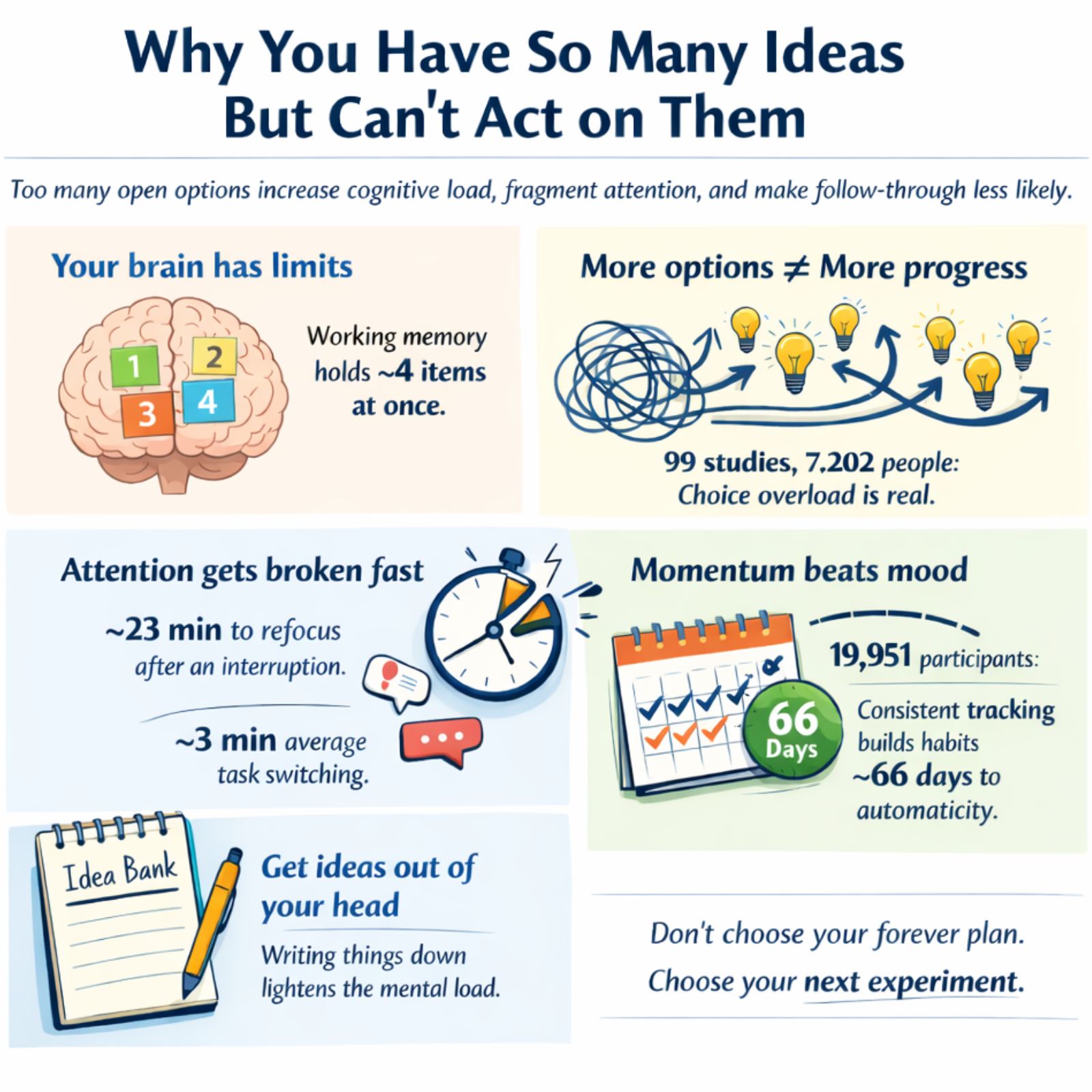
How to stop the cycle
Instead of chasing motivation, focus on staying in motion:
Expect motivation to drop - this isn’t failure. It’s part of the process.
Set a minimum action standard - on low days, do something small and keep the chain going.
Track consistency, not results - remember that progress builds from showing up, not from perfect outcomes.
How to Turn Ideas Into Action (Without Overcomplicating It)
Right now, everything probably feels like it needs a full plan - a clear strategy with a complete roadmap.
And that’s exactly why nothing starts.
Because you’re trying to go from idea to fully formed execution in one step, and that gap is too big. Your brain doesn’t know where to begin, so it delays.
This is where most productivity advice makes things worse. “Make a plan” sounds logical, but when you’re already overwhelmed, planning turns into more thinking, more tweaking, and no real movement.
So let’s strip it back.
You don’t need a full plan. You need a starting action!
Something small. Something visible. Something real.
The key is reducing everything down to one clear, manageable next step.
What that actually looks like
Instead of planning everything, focus on this:
Define the first concrete step - not the whole journey, just the first move.
Work in short timeframes - ask yourself: what can I realistically move forward this week?
Make it visible - write it, build it, share it - it helps that it exists outside your head.
Adjust as you go - let action shape direction, not the other way around.
This is how ideas become tangible - through movement, not overthinking.
Conclusion
If you’ve been stuck with too many ideas and not enough action, it’s not because you lack discipline or ambition. It’s because you’ve been trying to hold onto too much at once.
And when everything feels important, nothing gets done.
The shift is simpler than it seems. You don’t need better ideas or more motivation. You need a clear decision, a single direction, and the willingness to stay with it long enough to see what happens.
Because ultimately that’s where progress begins - not in the thinking and not in the planning but in the moment you choose something and move with it.
So start there!
Pick one idea. Give it your attention. And let action, not overthinking, show you what it’s worth.
A simpler way to turn ideas into action
If this feels familiar, the hard part isn’t coming up with ideas, it’s choosing what to do next.
Clarity Engine is part of the Defrazzle system designed to do exactly that.
It helps you take multiple ideas, compare them quickly, and turn them into one clear priority with a simple next step.
So instead of holding everything in your head, you get something concrete to move forward with.
Try the Clarity Engine and turn your ideas into a clear starting point:
References
Cowan, N. on working-memory capacity and the “about four chunks” estimate.
Chernev, Böckenholt, and Goodman, Choice overload: A conceptual review and meta-analysis.
Gloria Mark / UC Irvine research on interruptions and task switching.
Harkin et al., meta-analysis on progress monitoring and goal attainment.
You’re not short on ideas. You’re drowning in them.
There’s always something new pulling at your attention whether that's a business idea, a new routine, or a better way of doing things and, for just a moment, it feels like progress. Like you’re getting somewhere. But when it comes to actually committing to one thing and following through on it, everything seems to stall.
And, ultimately, that’s the frustrating part!
Because having ideas should be your strength. Instead, it leaves you stuck in this strange middle ground where you’re constantly thinking, planning, and rethinking but actually rarely moving.
So what’s actually going on?
The truth is - idea overload isn’t productivity, it’s often the thing preventing it. And the real issue isn’t creativity. It’s a lack of clear prioritisation. This is exactly the kind of problem the Defrazzle system is designed to solve - turning multiple competing ideas into a clear next step you can act on.
Let’s break this down properly because, once you see it clearly, it becomes much easier to fix.
The Hidden Problem With Having Too Many Ideas
You’ve probably had this thought before: “I know I’m capable of more than this.”
You’ve got ideas that feel solid. Some of them you’ve even half-started. But instead of building momentum, you find yourself circling back, hesitating, or quietly dropping things before they go anywhere.
But, here’s what’s actually happening.
When your head is full of ideas, your brain doesn’t organise them into a clear path forward. It tries to keep everything open, because every idea feels like something you might regret ignoring. Each one carries potential, and that potential makes it harder to let go.
So instead of choosing, you hold onto everything.
And the more options you keep active, the harder it becomes to commit. You end up stuck in a loop of evaluating and second-guessing, which slowly drains your ability to decide at all. This is where idea overload turns into decision fatigue.
Most advice tells you to “just start”, but that misses the point. The issue isn’t action. It’s trying to act while being pulled in multiple directions.
So here’s the shift:
You don’t have a motivation problem. You have a selection problem. And until you reduce your options, nothing (or very little) moves. What you need is a simple way to compare ideas and reduce them to one clear priority without overthinking it.
What to do instead
If you don’t have a system for this, your brain will try to hold everything at once. That’s what creates the friction. This is where you simplify things aggressively:
Get everything out of your head - write down every idea you’re holding onto. The goal is clarity, not organisation.
Pick one idea for the next 30 days - not the “best” idea. Just one you’re willing to commit to for now.
Create an idea bank for the rest - you’re not losing them. You’re just removing the pressure to act on all of them at once.
Lower the stakes - you’re not choosing your future. You’re choosing your next step.
Why Prioritisation Feels So Hard (And What You’re Avoiding)
You tell yourself you’ll commit to one idea when you feel more certain but that moment never quite arrives. Because no idea ever feels completely safe to choose.
What’s actually happening is quieter than that. Prioritisation forces you to close doors (even temporarily) and that creates tension. You start thinking about the opportunities you might miss or the time you might waste if you choose wrong.
So instead, you stay where it feels safer - in the idea phase where everything is still possible and nothing has been tested.
This is why most advice doesn’t land. You’ll hear things like “follow your passion” or “trust your gut”, but neither solves the real problem. They assume clarity comes first, when in reality, clarity comes from action.
That’s the part most people avoid.
So here’s the reframing that actually works:
You’re not choosing the perfect idea. You’re choosing the most useful next experiment. That’s it!
How to make the decision easier
Instead of overthinking it, use a simple filter (or a structured way to compare them):
Which idea feels easiest to start right now?
Which one solves a real, immediate problem?
Which one keeps coming back, even when you ignore it?
Then give yourself a deadline. No dragging it out. Pick one direction and move with it.
The Real Reason You Start and Then Stop
You’ve probably seen this pattern play out before.
You start something with energy and you make progress. It even feels like it’s working. But then the momentum drops, things slow down, and suddenly a new idea feels far more appealing.
So you switch. And the cycle repeats.
This isn’t a discipline problem - it’s a novelty loop!
New ideas feel good because they’re untouched. They’re full of potential and free from friction. But once you start something properly, you hit reality. Progress becomes slower, less exciting, and more uncertain.
That’s when your brain starts looking for an escape and a new idea provides one.
Most advice tells you to be more disciplined, but that only scratches the surface. The deeper issue is that you’ve been linking progress to excitement, when in reality, progress usually feels quite ordinary.
Sometimes repetitive and sometimes unclear.
That doesn’t mean it’s wrong. It means it’s real.
How to stop the cycle
Instead of chasing motivation, focus on staying in motion:
Expect motivation to drop - this isn’t failure. It’s part of the process.
Set a minimum action standard - on low days, do something small and keep the chain going.
Track consistency, not results - remember that progress builds from showing up, not from perfect outcomes.
How to Turn Ideas Into Action (Without Overcomplicating It)
Right now, everything probably feels like it needs a full plan - a clear strategy with a complete roadmap.
And that’s exactly why nothing starts.
Because you’re trying to go from idea to fully formed execution in one step, and that gap is too big. Your brain doesn’t know where to begin, so it delays.
This is where most productivity advice makes things worse. “Make a plan” sounds logical, but when you’re already overwhelmed, planning turns into more thinking, more tweaking, and no real movement.
So let’s strip it back.
You don’t need a full plan. You need a starting action!
Something small. Something visible. Something real.
The key is reducing everything down to one clear, manageable next step.
What that actually looks like
Instead of planning everything, focus on this:
Define the first concrete step - not the whole journey, just the first move.
Work in short timeframes - ask yourself: what can I realistically move forward this week?
Make it visible - write it, build it, share it - it helps that it exists outside your head.
Adjust as you go - let action shape direction, not the other way around.
This is how ideas become tangible - through movement, not overthinking.
Conclusion
If you’ve been stuck with too many ideas and not enough action, it’s not because you lack discipline or ambition. It’s because you’ve been trying to hold onto too much at once.
And when everything feels important, nothing gets done.
The shift is simpler than it seems. You don’t need better ideas or more motivation. You need a clear decision, a single direction, and the willingness to stay with it long enough to see what happens.
Because ultimately that’s where progress begins - not in the thinking and not in the planning but in the moment you choose something and move with it.
So start there!
Pick one idea. Give it your attention. And let action, not overthinking, show you what it’s worth.
A simpler way to turn ideas into action
If this feels familiar, the hard part isn’t coming up with ideas, it’s choosing what to do next.
Clarity Engine is part of the Defrazzle system designed to do exactly that.
It helps you take multiple ideas, compare them quickly, and turn them into one clear priority with a simple next step.
So instead of holding everything in your head, you get something concrete to move forward with.
Try the Clarity Engine and turn your ideas into a clear starting point:
References
Cowan, N. on working-memory capacity and the “about four chunks” estimate.
Chernev, Böckenholt, and Goodman, Choice overload: A conceptual review and meta-analysis.
Gloria Mark / UC Irvine research on interruptions and task switching.
Harkin et al., meta-analysis on progress monitoring and goal attainment.