Why You Avoid Responding to Messages (Even When You Want To)
Why You Avoid Responding to Messages (Even When You Want To)

You see the message come through.
You open it, read it properly, maybe even read it twice just to make sure you’ve understood what’s being asked or said… and then, for no particularly obvious reason, you don’t reply!
Not in a deliberate way, and not with any real intention of leaving it there, but more in that quiet, almost unnoticeable way where you think, “I’ll come back to this a bit later”, close it, and move on to something else.
At the time, it doesn’t feel like a decision, it just feels like a pause.
But what’s interesting is how often that pause stretches longer than you expect it to, and how something that should have taken a few seconds to respond slowly becomes something you’re more aware of than you’d like to be.
Because now it’s sitting there.
And the longer it sits there, the more it starts to feel like something you need to handle properly, rather than just reply to.
The Subtle Shift That Happens
If you look closely at the moment you decide not to reply, there’s usually a small shift happening in the background.
You’ve read the message, but instead of responding naturally, your attention moves inward for a second.
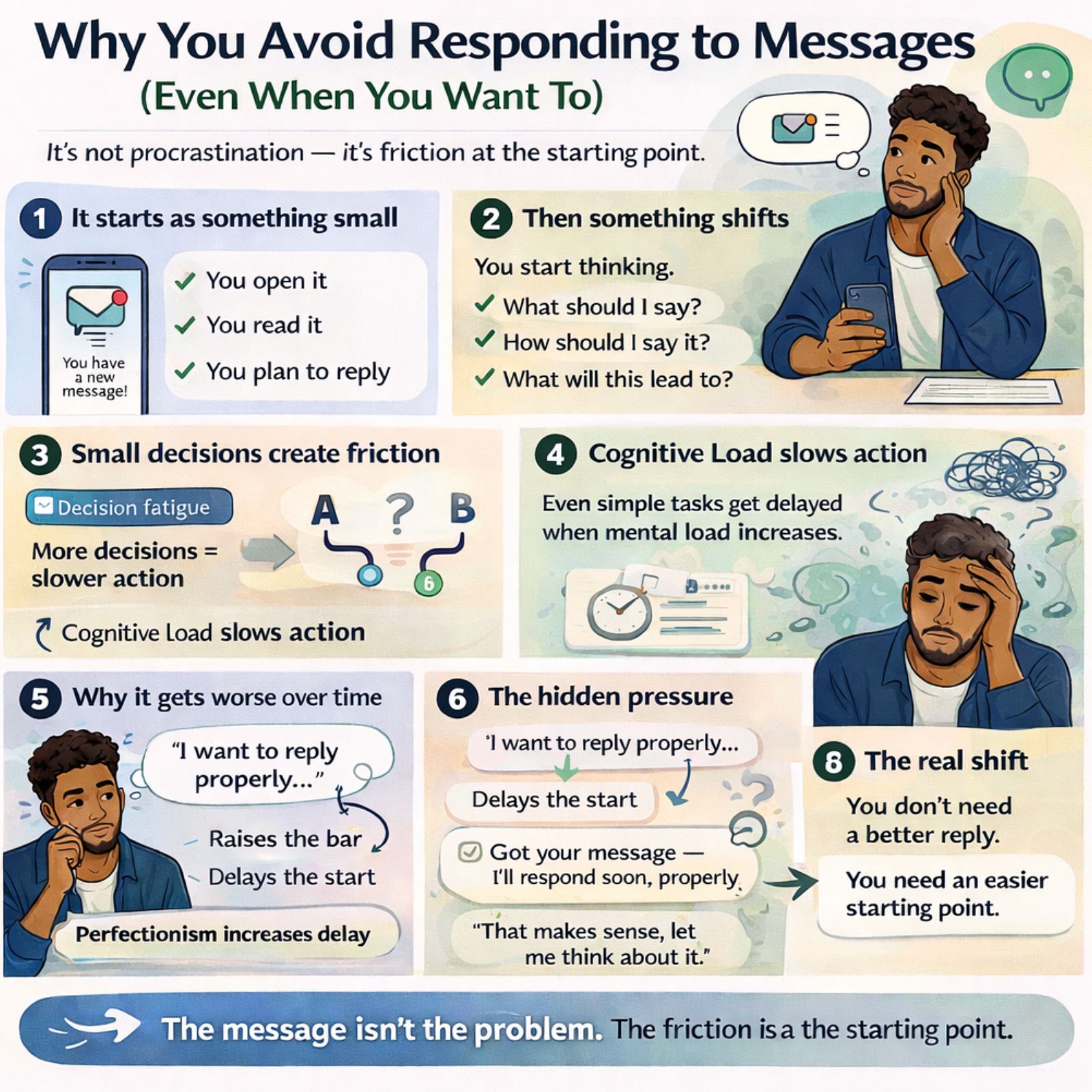
You start thinking about the response.
Not just what to say, but how to say it, how it might come across, whether it needs more context, whether it opens up another conversation you don’t quite have the energy for right now.
None of that feels particularly heavy on its own but together, in that moment, it’s just enough to interrupt what would otherwise have been a simple, automatic reply.
So instead of responding, you step away from it slightly. And that’s all it takes!
Because once the reply doesn’t happen immediately, it becomes something separate… something you now have to return to.
Why It Doesn’t Feel Like Procrastination (Even Though It Looks Like It)
From the outside, this is easy to label.
You saw the message. You didn’t reply. Therefore, you’re putting it off.
But that explanation never feels quite right because it’s not that you’re avoiding it in the usual sense.
You’re not thinking, “I don’t want to deal with this”.
If anything, you’re thinking the opposite:
“I want to reply to this properly.”
And that’s where the problem starts to take shape.
Because “properly” is too vague.
It doesn’t give you a clear starting point. It just raises the bar slightly higher than it needs to be. So now, instead of sending something simple, you’re holding off until you can send something better, clearer, more considered.
Which would be fine… if that moment reliably came! But in reality, it often doesn’t.
The Weight That Builds Without You Noticing
What’s interesting is how the message itself doesn’t change, but your relationship to it does.
At first, it’s just a message. Then it becomes a message you haven’t replied to yet. Then, after a bit more time passes, it becomes a message you probably should have replied to already.
And somewhere along that progression, the response starts to feel heavier than it originally was.
You begin to factor in things that weren’t there at the start.
Do I need to acknowledge the delay?
Should I explain why I didn’t reply sooner?
Does this now need more thought than it would have done earlier?
So the response that initially felt slightly unclear now feels more loaded, more considered and, as a result, slightly harder to approach which ultimately makes you less likely to reply in that moment. And so it stays where it is.
What’s Actually Causing the Friction
At its core, this isn’t really about the message, it’s about the starting point.
Because replying requires a small but specific set of decisions:
what to say;
how to say it; and
whether consciously or not, what that response might lead to next.
When those decisions feel easy, the reply happens almost automatically. However, when they don’t (even slightly) the process slows down and what’s missing isn’t effort, it’s a clear starting point you can use immediately. Not dramatically, just enough to create hesitation.
And hesitation, especially in something that could otherwise be quick, tends to lead to delay. And that is the friction - not the action itself, but the lack of a clear, low-effort way into the action.
This is exactly the kind of moment the Defrazzle system is designed for - giving you a simple way to start without needing to figure everything out first.
When It Starts to Feel Easier
The shift, when it happens, is usually quite subtle.
It’s not about becoming more responsive or more disciplined, and it’s not about forcing yourself to reply quicker than feels natural. It’s simply about removing some of the weight from the starting point.
The easier it is to begin, the more likely the response happens naturally.
That might mean responding before you’ve fully worked out the “perfect” reply or allowing yourself to send something that feels incomplete but still moves things forward. Even just acknowledging the message without trying to resolve it straight away.
None of those are particularly complex changes but they change the experience of replying quite significantly.
A Simpler Way In
In practice, what helps most is having something simple to start from so you’re not creating the response from scratch every time.
Not because they’re clever, but because they remove the need to decide everything upfront.
Something like:
“Got your message. I'll come back to you properly shortly.”
“That makes sense, let me think about it.”
“Quick reply for now…”
“My first thought is…”
There’s nothing special about these on their own but what they do is give you a way to begin without needing everything to be figured out first.
And once you’ve started, the rest is usually easier than it first felt.
Where This Shows Up Elsewhere
This isn’t really about messages.
It just happens to be a place where it’s easy to notice.
The same pattern tends to show up in other areas as well, for example starting tasks, making decisions, responding in conversations - anywhere really where there’s a small amount of uncertainty combined with a sense that you should “get it right”.
When the starting point feels unclear, the action tends to pause. That’s why having a simple way to begin makes such a difference.
Not because you can’t do it but because your brain doesn’t have a clean way in.
That’s also closely tied to what’s often described as cognitive load, where the more your mind is trying to process at once, the more likely it is to slow things down or step away from them entirely.
Conclusion
If you find yourself opening messages, reading them, and then not replying, it’s probably not a reflection of your organisation or your willingness to respond.
It’s more likely that, in that moment, the response didn’t feel simple enough to begin.
There was just enough uncertainty, just enough weight in how to approach it, that your brain chose to pause rather than push through and over time, those small pauses add up.
The change isn’t about forcing a different behaviour. It’s about making the starting point lighter.
Because when that part becomes easier, everything that follows tends to take care of itself!
A simpler way to respond without overthinking it
If replying to messages feels harder than it should, the problem usually isn’t the message - it’s not having a clear way to start.
Response Builder is part of the Defrazzle system designed to solve exactly that.
It gives you simple, ready-to-use responses so you don’t have to figure out what to say from scratch every time.
So instead of rereading, overthinking, or delaying, you get something clear you can send and keep things moving.
Try Response Builder and make replying feel easier:
References
You see the message come through.
You open it, read it properly, maybe even read it twice just to make sure you’ve understood what’s being asked or said… and then, for no particularly obvious reason, you don’t reply!
Not in a deliberate way, and not with any real intention of leaving it there, but more in that quiet, almost unnoticeable way where you think, “I’ll come back to this a bit later”, close it, and move on to something else.
At the time, it doesn’t feel like a decision, it just feels like a pause.
But what’s interesting is how often that pause stretches longer than you expect it to, and how something that should have taken a few seconds to respond slowly becomes something you’re more aware of than you’d like to be.
Because now it’s sitting there.
And the longer it sits there, the more it starts to feel like something you need to handle properly, rather than just reply to.
The Subtle Shift That Happens
If you look closely at the moment you decide not to reply, there’s usually a small shift happening in the background.
You’ve read the message, but instead of responding naturally, your attention moves inward for a second.
You start thinking about the response.
Not just what to say, but how to say it, how it might come across, whether it needs more context, whether it opens up another conversation you don’t quite have the energy for right now.
None of that feels particularly heavy on its own but together, in that moment, it’s just enough to interrupt what would otherwise have been a simple, automatic reply.
So instead of responding, you step away from it slightly. And that’s all it takes!
Because once the reply doesn’t happen immediately, it becomes something separate… something you now have to return to.
Why It Doesn’t Feel Like Procrastination (Even Though It Looks Like It)
From the outside, this is easy to label.
You saw the message. You didn’t reply. Therefore, you’re putting it off.
But that explanation never feels quite right because it’s not that you’re avoiding it in the usual sense.
You’re not thinking, “I don’t want to deal with this”.
If anything, you’re thinking the opposite:
“I want to reply to this properly.”
And that’s where the problem starts to take shape.
Because “properly” is too vague.
It doesn’t give you a clear starting point. It just raises the bar slightly higher than it needs to be. So now, instead of sending something simple, you’re holding off until you can send something better, clearer, more considered.
Which would be fine… if that moment reliably came! But in reality, it often doesn’t.
The Weight That Builds Without You Noticing
What’s interesting is how the message itself doesn’t change, but your relationship to it does.
At first, it’s just a message. Then it becomes a message you haven’t replied to yet. Then, after a bit more time passes, it becomes a message you probably should have replied to already.
And somewhere along that progression, the response starts to feel heavier than it originally was.
You begin to factor in things that weren’t there at the start.
Do I need to acknowledge the delay?
Should I explain why I didn’t reply sooner?
Does this now need more thought than it would have done earlier?
So the response that initially felt slightly unclear now feels more loaded, more considered and, as a result, slightly harder to approach which ultimately makes you less likely to reply in that moment. And so it stays where it is.
What’s Actually Causing the Friction
At its core, this isn’t really about the message, it’s about the starting point.
Because replying requires a small but specific set of decisions:
what to say;
how to say it; and
whether consciously or not, what that response might lead to next.
When those decisions feel easy, the reply happens almost automatically. However, when they don’t (even slightly) the process slows down and what’s missing isn’t effort, it’s a clear starting point you can use immediately. Not dramatically, just enough to create hesitation.
And hesitation, especially in something that could otherwise be quick, tends to lead to delay. And that is the friction - not the action itself, but the lack of a clear, low-effort way into the action.
This is exactly the kind of moment the Defrazzle system is designed for - giving you a simple way to start without needing to figure everything out first.
When It Starts to Feel Easier
The shift, when it happens, is usually quite subtle.
It’s not about becoming more responsive or more disciplined, and it’s not about forcing yourself to reply quicker than feels natural. It’s simply about removing some of the weight from the starting point.
The easier it is to begin, the more likely the response happens naturally.
That might mean responding before you’ve fully worked out the “perfect” reply or allowing yourself to send something that feels incomplete but still moves things forward. Even just acknowledging the message without trying to resolve it straight away.
None of those are particularly complex changes but they change the experience of replying quite significantly.
A Simpler Way In
In practice, what helps most is having something simple to start from so you’re not creating the response from scratch every time.
Not because they’re clever, but because they remove the need to decide everything upfront.
Something like:
“Got your message. I'll come back to you properly shortly.”
“That makes sense, let me think about it.”
“Quick reply for now…”
“My first thought is…”
There’s nothing special about these on their own but what they do is give you a way to begin without needing everything to be figured out first.
And once you’ve started, the rest is usually easier than it first felt.
Where This Shows Up Elsewhere
This isn’t really about messages.
It just happens to be a place where it’s easy to notice.
The same pattern tends to show up in other areas as well, for example starting tasks, making decisions, responding in conversations - anywhere really where there’s a small amount of uncertainty combined with a sense that you should “get it right”.
When the starting point feels unclear, the action tends to pause. That’s why having a simple way to begin makes such a difference.
Not because you can’t do it but because your brain doesn’t have a clean way in.
That’s also closely tied to what’s often described as cognitive load, where the more your mind is trying to process at once, the more likely it is to slow things down or step away from them entirely.
Conclusion
If you find yourself opening messages, reading them, and then not replying, it’s probably not a reflection of your organisation or your willingness to respond.
It’s more likely that, in that moment, the response didn’t feel simple enough to begin.
There was just enough uncertainty, just enough weight in how to approach it, that your brain chose to pause rather than push through and over time, those small pauses add up.
The change isn’t about forcing a different behaviour. It’s about making the starting point lighter.
Because when that part becomes easier, everything that follows tends to take care of itself!
A simpler way to respond without overthinking it
If replying to messages feels harder than it should, the problem usually isn’t the message - it’s not having a clear way to start.
Response Builder is part of the Defrazzle system designed to solve exactly that.
It gives you simple, ready-to-use responses so you don’t have to figure out what to say from scratch every time.
So instead of rereading, overthinking, or delaying, you get something clear you can send and keep things moving.
Try Response Builder and make replying feel easier: