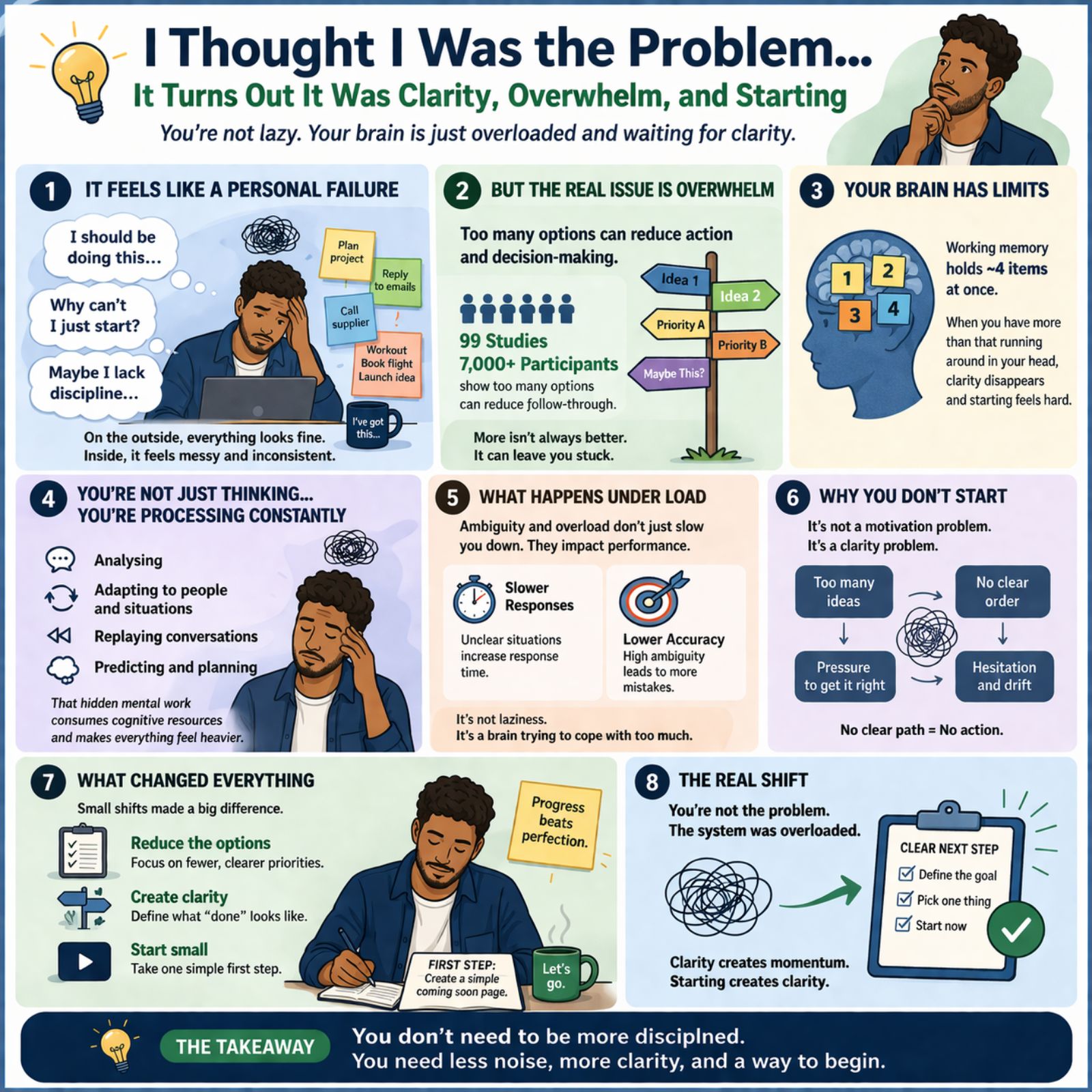
I Thought I Was the Problem. It Turns Out It Was Clarity, Overwhelm and Getting Started
I Thought I Was the Problem. It Turns Out It Was Clarity, Overwhelm and Getting Started

I used to sit down knowing I had things to do, fully aware that there were things that needed my attention, things that I had already thought about, planned, or even half-started…
and then do nothing.
Not in a dramatic or obvious way, and certainly not in a way that would have raised any real concern from the outside, but more in that quiet, slightly frustrating way where you open something, look at it, maybe move a few things around, and then somehow find yourself doing something else entirely without ever really deciding to.
At the time, I brushed it off as one of those things (everyone procrastinates occasionally, everyone has moments where they drift) but over time it became harder to ignore, mainly because it didn’t quite match the rest of how I operated.
Because it wasn’t that I didn’t have anything to do.
If anything, it was the complete opposite.
My Own Experience
There was always something in my head, and more often than not, it wasn’t just one thing but several, all running alongside each other, all feeling equally valid, equally interesting, and, this is maybe the most critical part, equally important. But there was no clear way to organise it into something I could act on.
That’s where it becomes difficult to explain unless you’ve experienced it yourself, because it isn’t like having a clear list where you can prioritise and work through it logically; it’s more like everything sits at the same level, so there’s no obvious place to begin, which means you don’t really begin anywhere in a meaningful way.
Instead, you drift between things.
You start one idea, then another one comes in that feels just as worth exploring, which then makes you question whether the first one was even the right place to start, so you open something else, circle back, hesitate again, and before you know it, you’ve spent time… but not actually moved anything forward.
At the same time, there were smaller patterns layered into this that, on their own, didn’t seem particularly significant but collectively added to the sense that something wasn’t quite working.
Overthinking conversations before they happened, then replaying them afterwards in more detail than was ever necessary. Opening messages, reading them, fully intending to reply, but then not doing so because the response didn’t quite feel right, or complete, or considered enough.
None of it was extreme.
But all of it was consistent.
What I Thought the Problem Was
So naturally, I assumed the issue was me.
That I was unmotivated, or at the very least less disciplined than I should be, that I lacked consistency, that I had a tendency to get bored too quickly and move on to the next thing instead of seeing anything through properly.
And if I’m honest, that conclusion didn’t come from anything anyone else said or suggested. It was entirely internal.
Because from the outside, things looked fine.
More than fine, in fact.
I had built a strong career, progressed into senior roles, and was trusted to deliver in environments where there was very little room for error. The output was there, the results were there, and there was nothing obvious that would have led anyone to question my ability or performance.
Additionally I have a fantastic family and a great friendship group too. Clearly what I found more difficult internally fortunately didn't impact my personal life too negatively.
Which, in a way, made it harder to reconcile.
Because while things were working externally, there was still this underlying sense that something wasn’t quite clicking internally - that things felt harder than they should have done, or at least harder than they appeared.
So the assumption became simple:
If everything looks fine on the outside, but feels inconsistent on the inside… then it must be me.
Why That Didn’t Quite Add Up
The more I paid attention to it, though, the less that explanation made sense.
Because I cared.
I cared about doing things properly, about delivering well, about showing up in a way that was credible and consistent, particularly in environments where it mattered.
And most importantly, I was doing those things.
I wasn’t underperforming. I wasn’t falling short. I was navigating complex conversations, leading teams, handling high-stakes situations, and doing it in a way that people trusted.
But what that didn’t show was the effort behind it.
The constant mental processing. The analysing, adjusting, adapting in real time. The way I would rely on reading the room and shaping how I showed up depending on who I was speaking to.
It worked.
But it also meant I was carrying more internally than was visible externally.
And that’s where the disconnect sat.
The Bit I Didn’t See at the Time
What I had always considered to be confidence was, in many ways, something slightly different.
It was adaptation.
It was the ability to read people quickly and adjust my behaviour, tone, and delivery in real time so that it aligned with the situation I was in.
And while that is, without question, a valuable skill, it also meant that I was constantly processing multiple layers of information at once - what I was saying, how it might be received, what others were saying, what they might be thinking, and how I should respond.
That works, until it doesn’t.
Because when you have the capacity for it, you can carry that load quite comfortably and even make it look effortless, but when you’re tired, or distracted, or your head is already full, that same process becomes significantly heavier.
That’s when things start to shift.
Conversations that would normally feel easy become harder to navigate. Simple responses take longer to form. At times, your mind goes completely blank in situations where you would normally be entirely at ease.
And that inconsistency is difficult to explain if you don’t understand what’s driving it.
The Turning Point
The shift didn’t come from pushing harder or trying to become more disciplined, because I had already tried that approach more than once and it never quite addressed the underlying issue.
Instead, it came from recognising something much simpler, and, in hindsight, much more obvious.
The problem wasn’t effort.
It was not knowing what to do with everything in my head.
What was missing was a simple way to turn all of that into something clear and actionable and that’s the gap Defrazzle is designed to fill.
There were too many ideas, too many possible directions, too many things competing for attention at the same time, all of which felt valid, all of which felt worth pursuing, but none of which had a clear structure or order to them.
Even when I started building Defrazzle, the same pattern showed up almost immediately.
The original intention was straightforward - a simple “coming soon” page, something minimal that allowed me to get started and build gradually.
That lasted all of a few minutes.
Because then it became, quite quickly, a much bigger list of “it would be good to include this” and “it probably needs that as well”, which, while all reasonable in isolation, collectively turned something simple into something far more complex than it needed to be at that stage.
And as a result, progress slowed.
Not because I didn’t know what I wanted to build, but because I was trying to build too much of it at once.
When It Started to Click
Once that pattern became visible, it became much easier to break things down into something manageable.
Whenever something felt unclear, I didn’t start.
Whenever there were too many options, I didn’t choose.
Whenever there was pressure to get something exactly right, I slowed down or stopped altogether.
There was no mystery to it.
It was simply a case of too much going on without enough clarity to support it. Without a structure to reduce that complexity, everything stayed open and that’s what made starting so difficult.
And what was equally noticeable was how quickly things began to shift when even a small amount of clarity was introduced.
Not dramatically, and certainly not perfectly, but enough to make starting feel easier, enough to make decisions feel lighter, and enough to create a sense of momentum that hadn’t been there before.
Where This All Leads
That, ultimately, is where Defrazzle comes from.
Not from a place of having everything perfectly structured or resolved, but from experiencing first-hand what it feels like when things are overloaded, slightly chaotic, and harder than they should be, and then seeing how much difference it makes when that complexity is reduced.
It isn’t about building elaborate systems or adding more layers.
It’s about turning unclear thoughts, tasks, and decisions into something simpler, clearer, and usable. That’s the principle behind each part of the Defrazzle system.
Because once that clarity is there, most of the resistance tends to fall away without needing to force it.
Conclusion
For a long time, I was convinced that I was the problem.
That I needed to be more focused, more consistent, more disciplined, and, in some way, fundamentally different in how I approached things.
But that wasn’t the case.
The real issue was clarity or, more accurately, the lack of it combined with a constant stream of ideas and no clear way to organise, prioritise, or start working through them.
Once that began to change, even in relatively small ways, everything else followed.
Not because I had changed, but because the way I was working finally made sense.
A simpler way to turn clarity into action
If this feels familiar, the issue isn’t effort, it’s trying to manage too much at once without a clear way to organise it.
Clarity Engine is part of the Defrazzle system designed to solve exactly that.
It helps you take everything you’re holding in your head, simplify it, and turn it into one clear priority with a practical next step.
So instead of circling between ideas or overthinking where to begin, you get something concrete you can move forward with.
Try the Clarity Engine and turn complexity into a clear starting point:
References
I used to sit down knowing I had things to do, fully aware that there were things that needed my attention, things that I had already thought about, planned, or even half-started…
and then do nothing.
Not in a dramatic or obvious way, and certainly not in a way that would have raised any real concern from the outside, but more in that quiet, slightly frustrating way where you open something, look at it, maybe move a few things around, and then somehow find yourself doing something else entirely without ever really deciding to.
At the time, I brushed it off as one of those things (everyone procrastinates occasionally, everyone has moments where they drift) but over time it became harder to ignore, mainly because it didn’t quite match the rest of how I operated.
Because it wasn’t that I didn’t have anything to do.
If anything, it was the complete opposite.
My Own Experience
There was always something in my head, and more often than not, it wasn’t just one thing but several, all running alongside each other, all feeling equally valid, equally interesting, and, this is maybe the most critical part, equally important. But there was no clear way to organise it into something I could act on.
That’s where it becomes difficult to explain unless you’ve experienced it yourself, because it isn’t like having a clear list where you can prioritise and work through it logically; it’s more like everything sits at the same level, so there’s no obvious place to begin, which means you don’t really begin anywhere in a meaningful way.
Instead, you drift between things.
You start one idea, then another one comes in that feels just as worth exploring, which then makes you question whether the first one was even the right place to start, so you open something else, circle back, hesitate again, and before you know it, you’ve spent time… but not actually moved anything forward.
At the same time, there were smaller patterns layered into this that, on their own, didn’t seem particularly significant but collectively added to the sense that something wasn’t quite working.
Overthinking conversations before they happened, then replaying them afterwards in more detail than was ever necessary. Opening messages, reading them, fully intending to reply, but then not doing so because the response didn’t quite feel right, or complete, or considered enough.
None of it was extreme.
But all of it was consistent.
What I Thought the Problem Was
So naturally, I assumed the issue was me.
That I was unmotivated, or at the very least less disciplined than I should be, that I lacked consistency, that I had a tendency to get bored too quickly and move on to the next thing instead of seeing anything through properly.
And if I’m honest, that conclusion didn’t come from anything anyone else said or suggested. It was entirely internal.
Because from the outside, things looked fine.
More than fine, in fact.
I had built a strong career, progressed into senior roles, and was trusted to deliver in environments where there was very little room for error. The output was there, the results were there, and there was nothing obvious that would have led anyone to question my ability or performance.
Additionally I have a fantastic family and a great friendship group too. Clearly what I found more difficult internally fortunately didn't impact my personal life too negatively.
Which, in a way, made it harder to reconcile.
Because while things were working externally, there was still this underlying sense that something wasn’t quite clicking internally - that things felt harder than they should have done, or at least harder than they appeared.
So the assumption became simple:
If everything looks fine on the outside, but feels inconsistent on the inside… then it must be me.
Why That Didn’t Quite Add Up
The more I paid attention to it, though, the less that explanation made sense.
Because I cared.
I cared about doing things properly, about delivering well, about showing up in a way that was credible and consistent, particularly in environments where it mattered.
And most importantly, I was doing those things.
I wasn’t underperforming. I wasn’t falling short. I was navigating complex conversations, leading teams, handling high-stakes situations, and doing it in a way that people trusted.
But what that didn’t show was the effort behind it.
The constant mental processing. The analysing, adjusting, adapting in real time. The way I would rely on reading the room and shaping how I showed up depending on who I was speaking to.
It worked.
But it also meant I was carrying more internally than was visible externally.
And that’s where the disconnect sat.
The Bit I Didn’t See at the Time
What I had always considered to be confidence was, in many ways, something slightly different.
It was adaptation.
It was the ability to read people quickly and adjust my behaviour, tone, and delivery in real time so that it aligned with the situation I was in.
And while that is, without question, a valuable skill, it also meant that I was constantly processing multiple layers of information at once - what I was saying, how it might be received, what others were saying, what they might be thinking, and how I should respond.
That works, until it doesn’t.
Because when you have the capacity for it, you can carry that load quite comfortably and even make it look effortless, but when you’re tired, or distracted, or your head is already full, that same process becomes significantly heavier.
That’s when things start to shift.
Conversations that would normally feel easy become harder to navigate. Simple responses take longer to form. At times, your mind goes completely blank in situations where you would normally be entirely at ease.
And that inconsistency is difficult to explain if you don’t understand what’s driving it.
The Turning Point
The shift didn’t come from pushing harder or trying to become more disciplined, because I had already tried that approach more than once and it never quite addressed the underlying issue.
Instead, it came from recognising something much simpler, and, in hindsight, much more obvious.
The problem wasn’t effort.
It was not knowing what to do with everything in my head.
What was missing was a simple way to turn all of that into something clear and actionable and that’s the gap Defrazzle is designed to fill.
There were too many ideas, too many possible directions, too many things competing for attention at the same time, all of which felt valid, all of which felt worth pursuing, but none of which had a clear structure or order to them.
Even when I started building Defrazzle, the same pattern showed up almost immediately.
The original intention was straightforward - a simple “coming soon” page, something minimal that allowed me to get started and build gradually.
That lasted all of a few minutes.
Because then it became, quite quickly, a much bigger list of “it would be good to include this” and “it probably needs that as well”, which, while all reasonable in isolation, collectively turned something simple into something far more complex than it needed to be at that stage.
And as a result, progress slowed.
Not because I didn’t know what I wanted to build, but because I was trying to build too much of it at once.
When It Started to Click
Once that pattern became visible, it became much easier to break things down into something manageable.
Whenever something felt unclear, I didn’t start.
Whenever there were too many options, I didn’t choose.
Whenever there was pressure to get something exactly right, I slowed down or stopped altogether.
There was no mystery to it.
It was simply a case of too much going on without enough clarity to support it. Without a structure to reduce that complexity, everything stayed open and that’s what made starting so difficult.
And what was equally noticeable was how quickly things began to shift when even a small amount of clarity was introduced.
Not dramatically, and certainly not perfectly, but enough to make starting feel easier, enough to make decisions feel lighter, and enough to create a sense of momentum that hadn’t been there before.
Where This All Leads
That, ultimately, is where Defrazzle comes from.
Not from a place of having everything perfectly structured or resolved, but from experiencing first-hand what it feels like when things are overloaded, slightly chaotic, and harder than they should be, and then seeing how much difference it makes when that complexity is reduced.
It isn’t about building elaborate systems or adding more layers.
It’s about turning unclear thoughts, tasks, and decisions into something simpler, clearer, and usable. That’s the principle behind each part of the Defrazzle system.
Because once that clarity is there, most of the resistance tends to fall away without needing to force it.
Conclusion
For a long time, I was convinced that I was the problem.
That I needed to be more focused, more consistent, more disciplined, and, in some way, fundamentally different in how I approached things.
But that wasn’t the case.
The real issue was clarity or, more accurately, the lack of it combined with a constant stream of ideas and no clear way to organise, prioritise, or start working through them.
Once that began to change, even in relatively small ways, everything else followed.
Not because I had changed, but because the way I was working finally made sense.
A simpler way to turn clarity into action
If this feels familiar, the issue isn’t effort, it’s trying to manage too much at once without a clear way to organise it.
Clarity Engine is part of the Defrazzle system designed to solve exactly that.
It helps you take everything you’re holding in your head, simplify it, and turn it into one clear priority with a practical next step.
So instead of circling between ideas or overthinking where to begin, you get something concrete you can move forward with.
Try the Clarity Engine and turn complexity into a clear starting point: