What to Do When Everything Feels Important
What to Do When Everything Feels Important

There is a particular kind of overwhelm that doesn’t announce itself in any obvious or dramatic way, but instead creeps in quietly through the back door, usually disguised as productivity.
It tends to show up at the point where you sit down, fully aware that there are things you need to do, perhaps even with a vague sense of motivation behind you, only to find that nothing quite happens in the way you expected.
Not because there is nothing to do. In fact, quite the opposite.
Because there is too much and, more specifically, too much that all feels important at the same time.
Which sounds, on the face of it, like a good problem to have.
Until you try to start.
The issue isn’t a lack of options - it’s not having a clear way to separate them into something you can act on.
That’s exactly the kind of problem the Defrazzle system is designed to solve.
Why Everything Ends Up Feeling Important
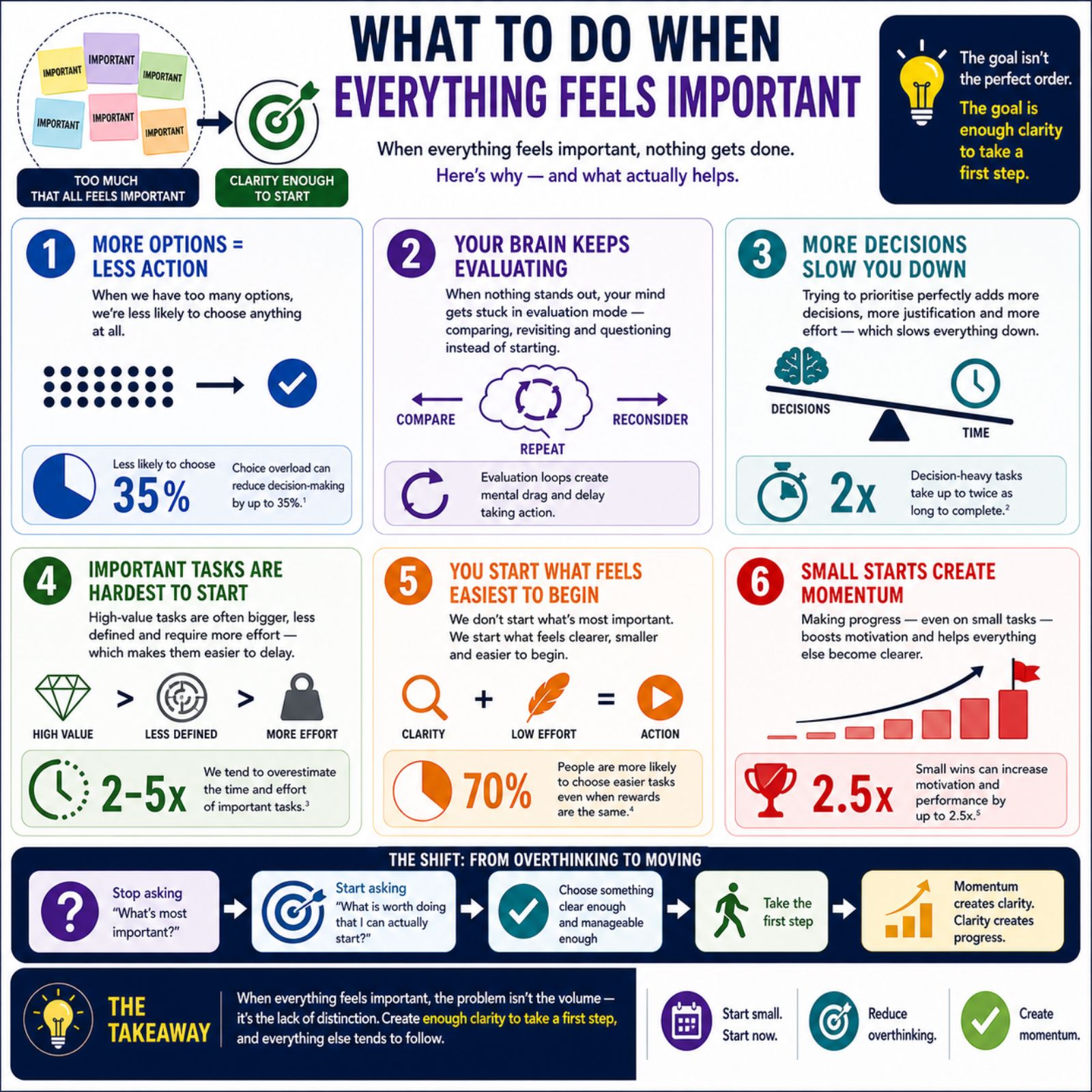
When everything feels important, it is rarely because everything genuinely is, but rather because nothing has been separated enough to stand out. Without that separation, everything competes equally for your attention.
Everything arrives with just enough weight attached to it to demand attention, yet not enough clarity to tell you whether it should come first, second, or at some undefined point in the future when you presumably have everything else under control.
So instead of moving, your mind does what it’s designed to do - it evaluates.
It moves between options, weighing them up, revisiting them, questioning whether one might be more valuable than another, or whether choosing one inevitably means neglecting something else that could turn out to be more significant.
And because there is no clear answer, the process continues.
Which, if we’re being honest, can feel a lot like progress. The problem is it isn’t!
It’s just thinking in circles, albeit quite productively presented, because nothing has been made clear enough to move on.
Why Trying to Prioritise Properly Often Makes It Worse
The logical response, of course, is to attempt to bring some order to it all.
To step back, take a breath, and work out properly what should come first, what can wait, and what perhaps doesn’t need doing at all.
A sensible approach and one I have tried more times than I can count.
Usually with a notebook open, a list half-written, and a growing suspicion that I am somehow making things more complicated than they need to be.
Because when everything already feels important, the act of trying to prioritise it perfectly doesn’t simplify the situation. It just adds another layer to it.
Now you’re not only deciding what to do, but also justifying why that decision is the correct one, often without having enough clarity to make that judgement in the first place.
Which is how you end up spending a perfectly good half hour reorganising a list you haven’t actually started.
Productive, technically. Progress… not so much!
The Shift That Changes How You Approach It
What eventually became more useful (though it took longer than I’d like to admit to arrive at!) was stepping away from the idea that there is a perfect order waiting to be discovered because, in most cases, there isn’t. At least not at the point where everything still lives in your head.
So instead of asking what is most important, which tends to invite more thinking than doing, the question becomes something far more practical:
What is worth doing that I can actually start?
It is a smaller question but it is also a far more useful one because it removes the need for certainty and replaces it with something you can act on.
Thinking in Terms of Value and Effort
This is where the idea of value versus effort starts to come into play, not as a formal system or a carefully constructed framework, but simply as a way of making sense of what is in front of you.
Some things will always appear more valuable.
They are the bigger ideas, the more ambitious plans, the things that feel like they should take priority.
They also tend to be the least defined, the most complex, and, coincidentally, the easiest to delay.
Other things, by contrast, may not carry quite the same weight on paper, but they are far easier to begin.
They require less thought, less setup, and far less negotiation with yourself before you can get going.
And when everything feels important, that distinction becomes far more useful than trying to determine what is objectively “most important”. It gives you a practical way to reduce everything down to something you can act on.
What This Looks Like in Practice
In practice, this rarely looks like a dramatic shift or a perfectly executed system. It is usually much simpler than that.
It might be choosing something smaller, even when a larger task is sitting there looking at you expectantly.
It might be starting with an idea that feels easier to explore, rather than the one that feels most significant.
Or it might simply be allowing yourself to begin without having worked out exactly how everything else fits together without needing to resolve everything else first.
I used to resist this more than I should have.
There was always a sense that I should be starting with the most important thing, or at the very least the thing that looked most impressive if completed.
In reality, those were often the very things I didn’t start at all.
Whereas the smaller, less intimidating tasks - the ones that didn’t feel quite as critical - were the ones that actually got done, and, more importantly, created enough momentum to make everything else feel more manageable.
Not ground-breaking but surprisingly effective!
Why This Works More Reliably Than Perfect Prioritisation
There is a certain appeal to the idea that if you could just organise everything correctly, you would naturally move through it in the right order, making steady, meaningful progress without hesitation.
It is a lovely idea! It just doesn’t tend to reflect how things actually work.
Because the most important things are often the hardest to define clearly enough to begin, and without that clarity, they remain exactly where they are - important, but untouched.
By contrast, when you allow yourself to begin with something that is simply clear enough and manageable enough, you introduce movement.
And movement, as it turns out, is far more useful than perfect prioritisation because, once you are moving, things begin to separate themselves.
Some tasks lose their urgency. Others become clearer. A few quietly disappear altogether, which is always a pleasant surprise.
Conclusion
When everything feels important, the problem is not the volume of what sits in front of you, but the lack of distinction between it.
Without a clear hierarchy, your mind continues to evaluate, compare, and reconsider, often without reaching a point where action feels justified.
And so things pause. Not because you are unwilling to act but because nothing has been made clear enough to begin.
The shift is not about finding the perfect order. It is about creating enough clarity to take a first step.
Not necessarily the right step. Just a step!
Because once that happens, everything else tends to follow with far less resistance than you might expect.
A simpler way to decide what to do next
If everything feels important, the issue isn’t effort, it’s not having a clear way to separate what actually matters right now.
Clarity Engine is part of the Defrazzle system designed to do exactly that.
It helps you take multiple ideas or tasks, compare them simply, and turn them into one clear priority with a practical next step.
So instead of trying to figure out the perfect order, you get something clear enough to start immediately.
Try Clarity Engine and turn overwhelm into a clear starting point:
References
There is a particular kind of overwhelm that doesn’t announce itself in any obvious or dramatic way, but instead creeps in quietly through the back door, usually disguised as productivity.
It tends to show up at the point where you sit down, fully aware that there are things you need to do, perhaps even with a vague sense of motivation behind you, only to find that nothing quite happens in the way you expected.
Not because there is nothing to do. In fact, quite the opposite.
Because there is too much and, more specifically, too much that all feels important at the same time.
Which sounds, on the face of it, like a good problem to have.
Until you try to start.
The issue isn’t a lack of options - it’s not having a clear way to separate them into something you can act on.
That’s exactly the kind of problem the Defrazzle system is designed to solve.
Why Everything Ends Up Feeling Important
When everything feels important, it is rarely because everything genuinely is, but rather because nothing has been separated enough to stand out. Without that separation, everything competes equally for your attention.
Everything arrives with just enough weight attached to it to demand attention, yet not enough clarity to tell you whether it should come first, second, or at some undefined point in the future when you presumably have everything else under control.
So instead of moving, your mind does what it’s designed to do - it evaluates.
It moves between options, weighing them up, revisiting them, questioning whether one might be more valuable than another, or whether choosing one inevitably means neglecting something else that could turn out to be more significant.
And because there is no clear answer, the process continues.
Which, if we’re being honest, can feel a lot like progress. The problem is it isn’t!
It’s just thinking in circles, albeit quite productively presented, because nothing has been made clear enough to move on.
Why Trying to Prioritise Properly Often Makes It Worse
The logical response, of course, is to attempt to bring some order to it all.
To step back, take a breath, and work out properly what should come first, what can wait, and what perhaps doesn’t need doing at all.
A sensible approach and one I have tried more times than I can count.
Usually with a notebook open, a list half-written, and a growing suspicion that I am somehow making things more complicated than they need to be.
Because when everything already feels important, the act of trying to prioritise it perfectly doesn’t simplify the situation. It just adds another layer to it.
Now you’re not only deciding what to do, but also justifying why that decision is the correct one, often without having enough clarity to make that judgement in the first place.
Which is how you end up spending a perfectly good half hour reorganising a list you haven’t actually started.
Productive, technically. Progress… not so much!
The Shift That Changes How You Approach It
What eventually became more useful (though it took longer than I’d like to admit to arrive at!) was stepping away from the idea that there is a perfect order waiting to be discovered because, in most cases, there isn’t. At least not at the point where everything still lives in your head.
So instead of asking what is most important, which tends to invite more thinking than doing, the question becomes something far more practical:
What is worth doing that I can actually start?
It is a smaller question but it is also a far more useful one because it removes the need for certainty and replaces it with something you can act on.
Thinking in Terms of Value and Effort
This is where the idea of value versus effort starts to come into play, not as a formal system or a carefully constructed framework, but simply as a way of making sense of what is in front of you.
Some things will always appear more valuable.
They are the bigger ideas, the more ambitious plans, the things that feel like they should take priority.
They also tend to be the least defined, the most complex, and, coincidentally, the easiest to delay.
Other things, by contrast, may not carry quite the same weight on paper, but they are far easier to begin.
They require less thought, less setup, and far less negotiation with yourself before you can get going.
And when everything feels important, that distinction becomes far more useful than trying to determine what is objectively “most important”. It gives you a practical way to reduce everything down to something you can act on.
What This Looks Like in Practice
In practice, this rarely looks like a dramatic shift or a perfectly executed system. It is usually much simpler than that.
It might be choosing something smaller, even when a larger task is sitting there looking at you expectantly.
It might be starting with an idea that feels easier to explore, rather than the one that feels most significant.
Or it might simply be allowing yourself to begin without having worked out exactly how everything else fits together without needing to resolve everything else first.
I used to resist this more than I should have.
There was always a sense that I should be starting with the most important thing, or at the very least the thing that looked most impressive if completed.
In reality, those were often the very things I didn’t start at all.
Whereas the smaller, less intimidating tasks - the ones that didn’t feel quite as critical - were the ones that actually got done, and, more importantly, created enough momentum to make everything else feel more manageable.
Not ground-breaking but surprisingly effective!
Why This Works More Reliably Than Perfect Prioritisation
There is a certain appeal to the idea that if you could just organise everything correctly, you would naturally move through it in the right order, making steady, meaningful progress without hesitation.
It is a lovely idea! It just doesn’t tend to reflect how things actually work.
Because the most important things are often the hardest to define clearly enough to begin, and without that clarity, they remain exactly where they are - important, but untouched.
By contrast, when you allow yourself to begin with something that is simply clear enough and manageable enough, you introduce movement.
And movement, as it turns out, is far more useful than perfect prioritisation because, once you are moving, things begin to separate themselves.
Some tasks lose their urgency. Others become clearer. A few quietly disappear altogether, which is always a pleasant surprise.
Conclusion
When everything feels important, the problem is not the volume of what sits in front of you, but the lack of distinction between it.
Without a clear hierarchy, your mind continues to evaluate, compare, and reconsider, often without reaching a point where action feels justified.
And so things pause. Not because you are unwilling to act but because nothing has been made clear enough to begin.
The shift is not about finding the perfect order. It is about creating enough clarity to take a first step.
Not necessarily the right step. Just a step!
Because once that happens, everything else tends to follow with far less resistance than you might expect.
A simpler way to decide what to do next
If everything feels important, the issue isn’t effort, it’s not having a clear way to separate what actually matters right now.
Clarity Engine is part of the Defrazzle system designed to do exactly that.
It helps you take multiple ideas or tasks, compare them simply, and turn them into one clear priority with a practical next step.
So instead of trying to figure out the perfect order, you get something clear enough to start immediately.
Try Clarity Engine and turn overwhelm into a clear starting point: