The Clarity Gap: Why Knowing What to Do Isn’t Enough
The Clarity Gap: Why Knowing What to Do Isn’t Enough

You already know what you need to do. At least, in a general sense.
You know you should:
start that project
have that conversation
make that decision
get moving on something you’ve been thinking about for a while
And yet… you don’t. Not consistently anyway and not in a way that creates real progress.
Which raises an obvious question:
If you already know what to do, why aren’t you doing it?
Because knowing what to do isn’t the same as having something clear enough to act on.
That’s exactly the gap the Defrazzle system is designed to close.
Most explanations default to motivation, discipline, or focus but that doesn’t quite hold up.
In many cases, the knowledge is there. The intent is there. Even the willingness is there. And still nothing moves! That’s where the gap sits.
Introducing the Clarity Gap
The problem isn’t a lack of knowledge. It’s a lack of actionable clarity.
Knowing something is not the same as being able to act on it.
That distinction is often overlooked because most systems, tools, and advice are built on a simple assumption:
Knowledge leads to action - but in reality, the pattern looks very different:
Knowledge → confusion → paralysis
You know what needs to happen but you don’t have a clear way to begin.
And without that, the knowledge doesn’t translate into movement. It just sits there - accurate, useful, and unused.
That’s what we define as The Clarity Gap.
Breaking Down the Gap
The Clarity Gap doesn’t come from one single issue.
It tends to form through a combination of three layers, each of which adds just enough friction to stop action from happening.
Vague Outcomes
At the top level, the outcome itself is often unclear.
Not in intent, but in definition.
You might be aiming to:
“get organised”
“improve things”
“sort everything out”
All of which feel directionally correct but none of which are specific enough to act on.
They describe a state, not an action.
And without something concrete, your brain has nothing to anchor to so it delays.
Unclear Structure
Even when the outcome is clearer, the structure often isn’t.
You might know what you want to achieve, but not:
what the steps are
what order they should happen in
what actually moves things forward
So instead of acting, your brain tries to work that out first and that process quickly becomes heavy.
Because you’re not just doing the task, you’re trying to design the process and execute it at the same time and that’s where things start to slow down.
No Entry Point
This is where things tend to stop completely.
Even if you:
understand the outcome
have a rough sense of structure
If there’s no clear starting point, nothing happens because starting requires a specific decision:
What do I do first?
And if that decision isn’t obvious, your brain hesitates.
Not because the task is impossible but because the entry point isn’t clear enough to begin without thinking and when starting requires too much thinking, your brain delays.
That’s the final layer of the gap.
Why Most Tools Fail
Most tools are built to help you manage information.
They allow you to:
capture ideas
store tasks
organise notes
track activity
And they do that well. But that’s not where the problem sits.
The problem isn’t having information. It’s turning that information into something you can actually act on. That missing step (turning information into action) is where the Clarity Gap sits.
And this is where most tools fall short because they assume that once something is written down or organised, the next step is obvious. But it often isn’t.
So what you’re left with is:
a clear list
well-structured information
and no movement
Because the Clarity Gap hasn’t been addressed.
Reframing Clarity
Clarity is often misunderstood as simply “knowing what’s going on” but that version of clarity doesn’t create action.
The version that does is more specific.
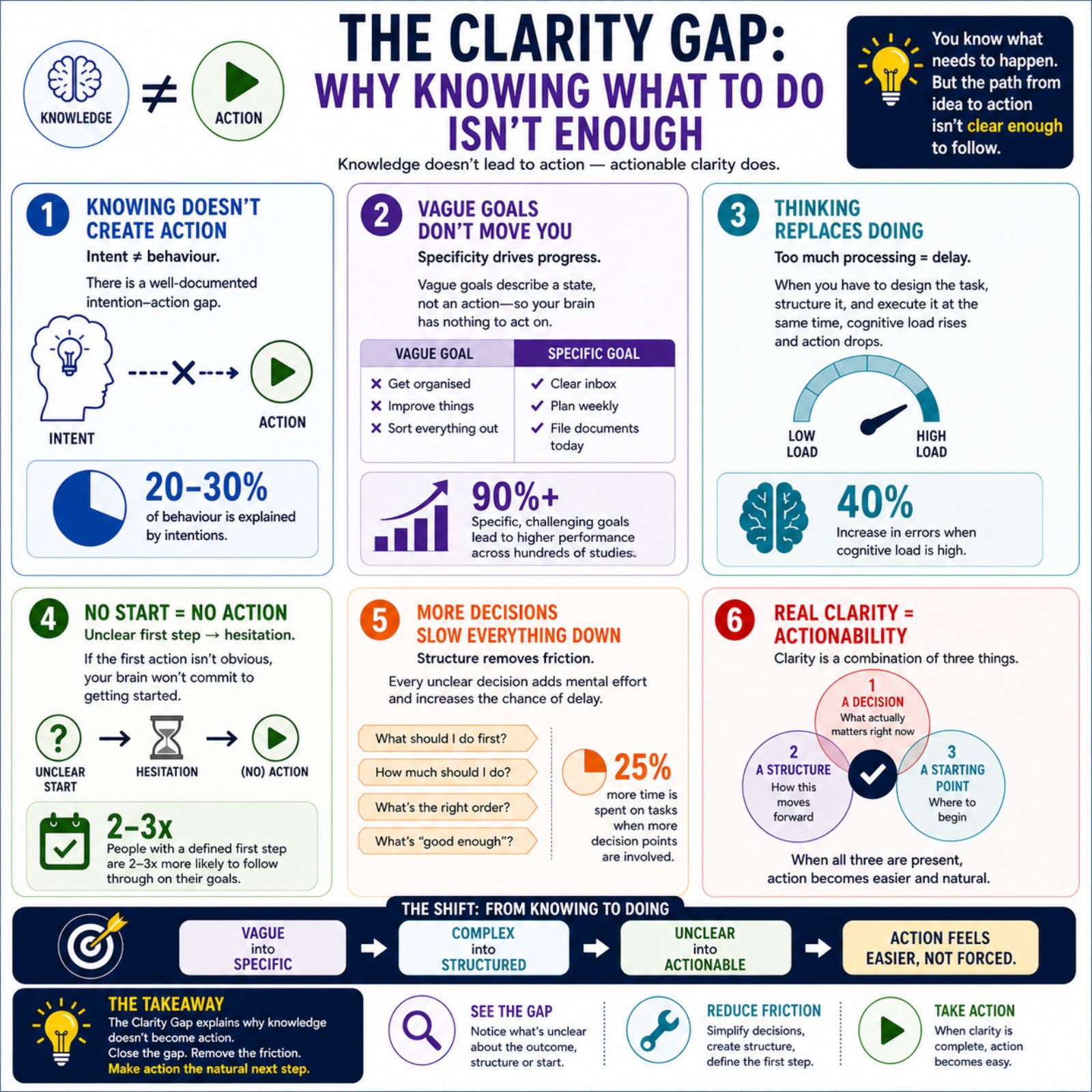
Clarity is not awareness. It’s usability and the combination of three things:
A decision → what actually matters right now
A structure → how that moves forward
A starting point → where to begin
When all three are present, action becomes much easier because you’re no longer figuring things out, you’re following something clear.
Not because the task has changed but because the friction around it has been removed.
Why This Matters
Without clarity, even simple things can feel heavy.
You can:
know what needs to happen
want to make progress
and still not move
Which often gets misinterpreted as:
procrastination
lack of discipline
lack of focus
When in reality, it’s none of those things. It’s a structural problem.
There’s a gap between knowing and doing and until that gap is addressed, effort alone won’t solve it. In fact, that gap only closes when what you know becomes something you can immediately act on.
Conclusion
The Clarity Gap explains a pattern most people recognise but struggle to articulate.
You know what to do but that knowledge doesn’t translate into action.
Not because you’re incapable but because the path from idea to action isn’t clear enough to follow.
The shift isn’t about more information. It’s about making that information usable.
Turning:
vague into specific
complex into structured
unclear into actionable
Because once something is clear in that way, action stops feeling forced and starts to feel natural.
A simpler way to turn clarity into action
If you know what needs to be done but still find it hard to start, the issue isn’t motivation, it’s that the next step isn’t clear enough to act on.
Clarity Engine is part of the Defrazzle system designed to close that gap.
It helps you take ideas, tasks, or decisions and turn them into a clear priority, a simple structure, and a practical first step you can actually begin.
So instead of holding everything in your head or trying to figure it out as you go, you get something concrete to move forward with.
Try Clarity Engine and turn knowing into doing:
References
You already know what you need to do. At least, in a general sense.
You know you should:
start that project
have that conversation
make that decision
get moving on something you’ve been thinking about for a while
And yet… you don’t. Not consistently anyway and not in a way that creates real progress.
Which raises an obvious question:
If you already know what to do, why aren’t you doing it?
Because knowing what to do isn’t the same as having something clear enough to act on.
That’s exactly the gap the Defrazzle system is designed to close.
Most explanations default to motivation, discipline, or focus but that doesn’t quite hold up.
In many cases, the knowledge is there. The intent is there. Even the willingness is there. And still nothing moves! That’s where the gap sits.
Introducing the Clarity Gap
The problem isn’t a lack of knowledge. It’s a lack of actionable clarity.
Knowing something is not the same as being able to act on it.
That distinction is often overlooked because most systems, tools, and advice are built on a simple assumption:
Knowledge leads to action - but in reality, the pattern looks very different:
Knowledge → confusion → paralysis
You know what needs to happen but you don’t have a clear way to begin.
And without that, the knowledge doesn’t translate into movement. It just sits there - accurate, useful, and unused.
That’s what we define as The Clarity Gap.
Breaking Down the Gap
The Clarity Gap doesn’t come from one single issue.
It tends to form through a combination of three layers, each of which adds just enough friction to stop action from happening.
Vague Outcomes
At the top level, the outcome itself is often unclear.
Not in intent, but in definition.
You might be aiming to:
“get organised”
“improve things”
“sort everything out”
All of which feel directionally correct but none of which are specific enough to act on.
They describe a state, not an action.
And without something concrete, your brain has nothing to anchor to so it delays.
Unclear Structure
Even when the outcome is clearer, the structure often isn’t.
You might know what you want to achieve, but not:
what the steps are
what order they should happen in
what actually moves things forward
So instead of acting, your brain tries to work that out first and that process quickly becomes heavy.
Because you’re not just doing the task, you’re trying to design the process and execute it at the same time and that’s where things start to slow down.
No Entry Point
This is where things tend to stop completely.
Even if you:
understand the outcome
have a rough sense of structure
If there’s no clear starting point, nothing happens because starting requires a specific decision:
What do I do first?
And if that decision isn’t obvious, your brain hesitates.
Not because the task is impossible but because the entry point isn’t clear enough to begin without thinking and when starting requires too much thinking, your brain delays.
That’s the final layer of the gap.
Why Most Tools Fail
Most tools are built to help you manage information.
They allow you to:
capture ideas
store tasks
organise notes
track activity
And they do that well. But that’s not where the problem sits.
The problem isn’t having information. It’s turning that information into something you can actually act on. That missing step (turning information into action) is where the Clarity Gap sits.
And this is where most tools fall short because they assume that once something is written down or organised, the next step is obvious. But it often isn’t.
So what you’re left with is:
a clear list
well-structured information
and no movement
Because the Clarity Gap hasn’t been addressed.
Reframing Clarity
Clarity is often misunderstood as simply “knowing what’s going on” but that version of clarity doesn’t create action.
The version that does is more specific.
Clarity is not awareness. It’s usability and the combination of three things:
A decision → what actually matters right now
A structure → how that moves forward
A starting point → where to begin
When all three are present, action becomes much easier because you’re no longer figuring things out, you’re following something clear.
Not because the task has changed but because the friction around it has been removed.
Why This Matters
Without clarity, even simple things can feel heavy.
You can:
know what needs to happen
want to make progress
and still not move
Which often gets misinterpreted as:
procrastination
lack of discipline
lack of focus
When in reality, it’s none of those things. It’s a structural problem.
There’s a gap between knowing and doing and until that gap is addressed, effort alone won’t solve it. In fact, that gap only closes when what you know becomes something you can immediately act on.
Conclusion
The Clarity Gap explains a pattern most people recognise but struggle to articulate.
You know what to do but that knowledge doesn’t translate into action.
Not because you’re incapable but because the path from idea to action isn’t clear enough to follow.
The shift isn’t about more information. It’s about making that information usable.
Turning:
vague into specific
complex into structured
unclear into actionable
Because once something is clear in that way, action stops feeling forced and starts to feel natural.
A simpler way to turn clarity into action
If you know what needs to be done but still find it hard to start, the issue isn’t motivation, it’s that the next step isn’t clear enough to act on.
Clarity Engine is part of the Defrazzle system designed to close that gap.
It helps you take ideas, tasks, or decisions and turn them into a clear priority, a simple structure, and a practical first step you can actually begin.
So instead of holding everything in your head or trying to figure it out as you go, you get something concrete to move forward with.
Try Clarity Engine and turn knowing into doing: